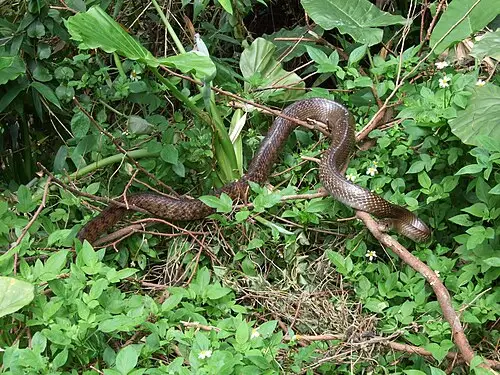
 📸 Photo
Photo: Allentchang · CC BY 2.5 · Wikimedia Commons Source
Taiwan Stink Snake
Elaphe carinata (Taiwan Stink Snake · シュウダ)
💡 Everyday Comparisons for Size, Mass & Speed
- 💡 Taiwan's National Museum of Natural Science explains that this snake got its name because the pattern on its snout resembles the Chinese character for "king" (wang).
- 💡 On Orchid Island (Lanyu) in Taiwan, it preys on small mammals such as rodents and birds in forests, farmlands, and sisal plantations, and has virtually no natural predators apart from birds of prey.
Reference standards: coach bus ~12 m, mid-size car ~4.9 m, compact car ~1 t, basketball hoop 3.05 m, credit card 8.56 cm.
📖 1. Overview
The Taiwan Stink Snake (King Ratsnake) is a large non-venomous snake living in Taiwan and southern China that preys on rodents, birds, and frogs in forests and farmlands.
🦴 2. Anatomy & Morphology
Because the scale pattern from its mouth to its eyes resembles the Chinese character for "king" (wang), it is given the name "king." Juveniles are brown while adults have white spots scattered on an ash-grey background, and large belly scales help it climb rocks and trees well.
🔍 3. Ecology & Behavior
It eats small mammals such as rodents, birds, and frogs, coiling around prey to suffocate it before swallowing, and sometimes preys on its own species. In summer it lays 8–14 eggs and guards the nest.
🇰🇷 4. Connection to Korea
No direct record connecting this species to Korea has been found.
📚 Sources & References
- • IUCN Red List LC (2021) — https://www.iucnredlist.org/species/192025/2029654
- • IUCN Red List category LC — latest assessment at iucnredlist.org
- • catalogueoflife.org — 38YKN
- • iucnredlist.org — 2029654
- • wikidata.org — Q716276
- • commons.wikimedia.org — File:Elaphe carinata in Soochow University 20070428.jpg
- • nmns.edu.tw — Collection-E00544
- • Silhouette: PhyloPic — Alex Slavenko · CC0 1.0 (Congeneric silhouette — Elaphe quatuorlineata)
Recorded dimensions are widely cited representative estimates from public literature and may vary by study or specimen.