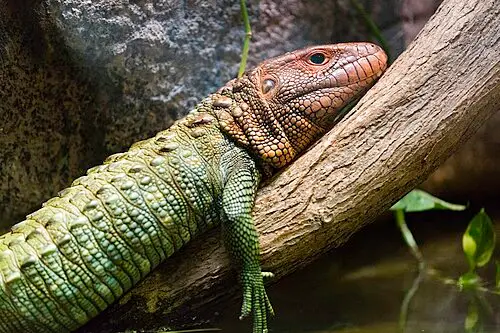
 📸 Photo
Photo: Brett Weinstein · CC BY-SA 3.0 · Wikimedia Commons Source
Northern Caiman Lizard
Dracaena guianensis (Northern Caiman Lizard · ガイアナカイマントカゲ)
💡 Everyday Comparisons for Size, Mass & Speed
- 💡 Its length of about 1.2 m is around the height of a lower-grade elementary school child, and its weight of about 2.7 kg is slightly lighter than a 3 kg bag of rice (Comparison).
- 💡 Heavily hunted for leather goods in the mid-to-late 20th century, wild populations recovered after export bans and regulations in the 1990s, though illegal pet trade remains a threat (San Francisco Zoo).
Reference standards: coach bus ~12 m, mid-size car ~4.9 m, compact car ~1 t, basketball hoop 3.05 m, credit card 8.56 cm.
Site-computed relative index from recorded values; not a formal scientific metric.
📖 1. Overview
The Northern Caiman Lizard is a lizard living along waterways in South American tropical forests, specialized for feeding on snails and clams.
🦴 2. Anatomy & Morphology
It has a green body and a reddish head, and the crocodile-like scales on its back give it its name. Its long, flattened tail acts as an oar when swimming, and a transparent third eyelid serves as goggles underwater.
🔍 3. Ecology & Behavior
It feeds mainly on snails and clams, crushing the shells with its powerful jaws, swallowing the meat, and spitting out the shell fragments. Females dig burrows in riverbanks to lay eggs and do not care for the young.
🇰🇷 4. Connection to Korea
No direct record connecting this species to Korea has been found.
📚 Sources & References
- • IUCN Red List LC (2019) — https://www.iucnredlist.org/species/44579645/44579652
- • IUCN Red List category LC — latest assessment at iucnredlist.org
- • catalogueoflife.org — 6DJFS
- • iucnredlist.org — 44579652
- • wikidata.org — Q959172
- • commons.wikimedia.org — File:Caiman Lizard.jpg
- • sfzoo.org — caiman-lizard
- • Silhouette: PhyloPic — Andy Wilson · CC0 1.0
Recorded dimensions are widely cited representative estimates from public literature and may vary by study or specimen.