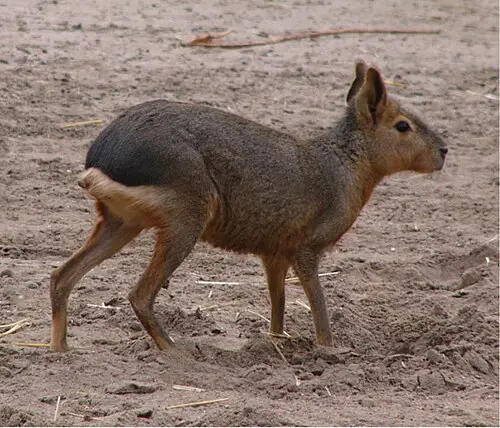
 📸 Photo
Photo: Diana · CC BY-SA 3.0 · Wikimedia Commons Source
Patagonian Mara
Dolichotis patagonum (Patagonian Mara · マーラ)
💡 Everyday Comparisons for Size, Mass & Speed
- 💡 It is used as a walk-through exhibit animal in zoos, and when trained it can even be walked on a leash.
- 💡 Its average weight of 8.12 kg is slightly lighter than a 10 kg bag of rice (Comparison).
- 💡 In Argentina its hide is used for bedspreads and rugs, and its meat is also eaten.
Reference standards: coach bus ~12 m, mid-size car ~4.9 m, compact car ~1 t, basketball hoop 3.05 m, credit card 8.56 cm.
Site-computed relative index from recorded values; not a formal scientific metric.
📖 1. Overview
The Patagonian Mara is a large rodent living in the dry regions of Argentina, with long legs and rabbit-like ears.
🦴 2. Anatomy & Morphology
It is characterized by long rabbit-like ears (its scientific name means 'long ear') and a short, nearly hairless tail. Its body resembles that of a hoofed animal, with 4 toes on the front feet and 3 toes on the hind feet.
🔍 3. Ecology & Behavior
Active during the day, it travels in lifelong monogamous pairs, and grasses make up about 70% of its diet. It moves by walking, hopping like a rabbit, or bouncing on all fours, and eats its own droppings again to absorb more nutrients.
🇰🇷 4. Connection to Korea
No direct record connecting this species to Korea has been found.
📚 Sources & References
- • IUCN Red List NT (2016) — https://www.iucnredlist.org/species/6785/22190337
- • IUCN Red List category NT — latest assessment at iucnredlist.org
- • mammaldiversity.org — 1001207
- • iucnredlist.org — 22190337
- • wikidata.org — Q194313
- • commons.wikimedia.org — File:Mara 1.jpg
- • animaldiversity.org — Dolichotis patagonum
- • nationalzoo.si.edu — patagonian-mara
- • Silhouette: PhyloPic — author not recorded · CC0 1.0
Recorded dimensions are widely cited representative estimates from public literature and may vary by study or specimen.