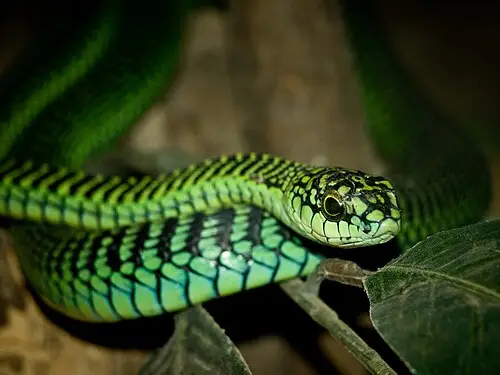
 📸 Photo
Photo: William Warby from London, England · CC BY 2.0 · Wikimedia Commons Source
Boomslang
Dispholidus typus (Boomslang · ブームスラング)
💡 Everyday Comparisons for Size, Mass & Speed
- 💡 Its average length of 1.5 m is about twice the length of an adult human arm (Comparison).
- 💡 Animal Diversity Web notes that while no direct benefit to humans is documented, Boomslang venom may be useful in researching blood-damaging (hemotoxic) venoms and developing treatments.
Reference standards: coach bus ~12 m, mid-size car ~4.9 m, compact car ~1 t, basketball hoop 3.05 m, credit card 8.56 cm.
📖 1. Overview
The Boomslang is a long, slender arboreal snake living in Africa that is active by day and possesses potent venom.
🦴 2. Anatomy & Morphology
It has a long, slender body, a small, blunt, egg-shaped head, and very large eyes. Females are generally greenish-brown, whereas males display a much wider range of colors including olive, bright green, and black.
🔍 3. Ecology & Behavior
Gliding through branches, it mainly hunts small arboreal lizards such as chameleons and frogs, and also eats birds, eggs, small mammals, and even other Boomslangs. Mating takes place in December–January, and eggs are laid in rotting stumps or leaf litter.
🇰🇷 4. Connection to Korea
No direct record connecting this species to Korea has been found.
📚 Sources & References
- • IUCN Red List LC (2021) — https://www.iucnredlist.org/species/190603/15357215
- • IUCN Red List category LC — latest assessment at iucnredlist.org
- • catalogueoflife.org — 36VHQ
- • iucnredlist.org — 15357215
- • wikidata.org — Q893048
- • commons.wikimedia.org — File:Dispholidus typus.jpg
- • animaldiversity.org — Dispholidus typus
- • Silhouette: PhyloPic — Alex Slavenko · CC0 1.0 (Related taxon silhouette — Elaphe quatuorlineata)
Recorded dimensions are widely cited representative estimates from public literature and may vary by study or specimen.