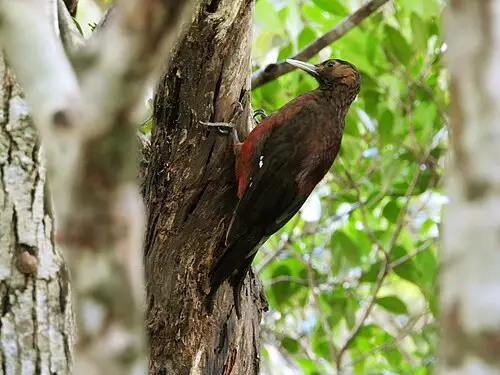
 📸 Photo
Photo: Amateras7777 · CC BY-SA 4.0 · Wikimedia Commons Source
Okinawa Woodpecker
Dendrocopos noguchii (Okinawa Woodpecker · ノグチゲラ)
💡 Everyday Comparisons for Size, Mass & Speed
- 💡 Its body length of 31 cm is similar to the long side of an A4 sheet of paper (29.7 cm) (Comparison).
- 💡 As a national Special Natural Monument of Japan and a National Endangered Species, Okinawa Prefecture's official profile carries a notice that it is protected under the Species Conservation Act and the Law for the Protection of Cultural Properties.
- 💡 Its Okinawan dialect name is 'Kiitatachaa,' introduced directly on the Okinawa prefectural environment department's wildlife guide website.
Reference standards: coach bus ~12 m, mid-size car ~4.9 m, compact car ~1 t, basketball hoop 3.05 m, credit card 8.56 cm.
📖 1. Overview
The Okinawa woodpecker is a woodpecker endemic to Japan that lives only in the northern forests of Okinawa Island. Designated a Special Natural Monument of Japan, it cannot be seen outside the Yambaru forest.
🦴 2. Anatomy & Morphology
Its body is dark brown with red-tipped feathers and white spots on the wings. Young birds of both sexes have a reddish tinge on the crown, but in adults the female's crown turns dark blackish-brown. It excavates wood with a very strong bill.
🔍 3. Ecology & Behavior
It eats large arthropods such as insects and spiders as well as tree fruits. During the breeding season it excavates nest holes in broadleaf trees such as Castanopsis sieboldii (Itajii) and mates with the same partner year after year. For breeding, it requires forests at least 30 years old with tall trees.
🇰🇷 4. Connection to Korea
No direct record connecting this species to Korea has been found.
📚 Sources & References
- • IUCN Red List EN (2024) — https://www.iucnredlist.org/species/22681531/269626123
- • IUCN Red List category EN — latest assessment at iucnredlist.org
- • doi.org — avilist.v2026
- • iucnredlist.org — 269626123
- • wikidata.org — Q21948535
- • commons.wikimedia.org — File:ノグチゲラ ドラミング準備中 20190426.jpg
- • biodiversity.okinawa — noguchigera.html
- • biologicaldiversity.org — natural history.html
- • Silhouette: PhyloPic — Steven Traver · CC0 1.0 (Congeneric silhouette — Dendrocopos major)
Recorded dimensions are widely cited representative estimates from public literature and may vary by study or specimen.