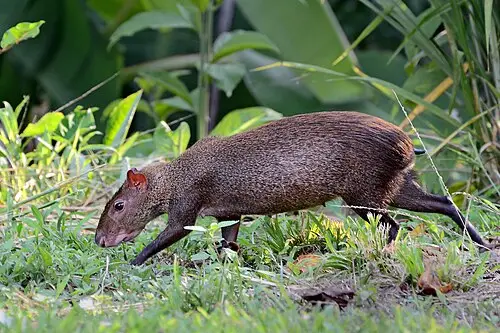
 📸 Photo
Photo: Geoff Gallice · CC BY 2.0 · Wikimedia Commons Source
Central American Agouti
Dasyprocta punctata (Central American Agouti · Central American Agouti)
💡 Everyday Comparisons for Size, Mass & Speed
- 💡 In its range, people commonly hunt it for food, and because it tames easily it is also kept as a pet.
- 💡 Trees sprout from the seeds it hides, making it an important disperser of forest tree seeds.
- 💡 Its maximum weight of 4 kg equals a 4 kg bag of rice (Comparison).
Reference standards: coach bus ~12 m, mid-size car ~4.9 m, compact car ~1 t, basketball hoop 3.05 m, credit card 8.56 cm.
Site-computed relative index from recorded values; not a formal scientific metric.
📖 1. Overview
The Central American Agouti is a slender rodent that eats forest fruits and buries seeds in the ground, helping forests spread.
🦴 2. Anatomy & Morphology
Its coat is coarse yet glossy, ranging from pale orange to brown with a contrasting rump. Each hind foot has 3 toes with hoof-like claws, and its tail is short at 10–35 mm.
🔍 3. Ecology & Behavior
It feeds mainly on fruits, burying seeds when fruit is abundant and digging them up when fruit is scarce. A lifelong monogamous pair defends a territory of 1–2 ha and usually produces two young.
🇰🇷 4. Connection to Korea
No direct record connecting this species to Korea has been found.
📚 Sources & References
- • IUCN Red List LC (2016) — https://www.iucnredlist.org/species/89497686/78319610
- • IUCN Red List category LC — latest assessment at iucnredlist.org
- • mammaldiversity.org — 1001225
- • iucnredlist.org — 78319610
- • wikidata.org — Q1762247
- • commons.wikimedia.org — File:Dasyprocta punctata (Gamboa, Panama).jpg
- • animaldiversity.org — Dasyprocta punctata
- • Silhouette: PhyloPic — Graham Montgomery · CC BY 4.0
Recorded dimensions are widely cited representative estimates from public literature and may vary by study or specimen.