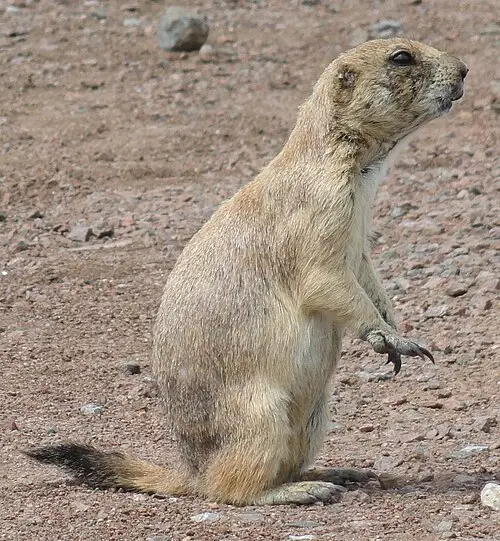
 📸 Photo
Photo: LeonardoWeiss · CC BY 3.0 · Wikimedia Commons Source
Black-tailed Prairie Dog
Cynomys ludovicianus (Black-tailed Prairie Dog · オグロプレーリードッグ)
💡 Everyday Comparisons for Size, Mass & Speed
- 💡 Its maximum weight of 1.675 kg is about one and a half 1 kg bags of rice, and its total length of 41.5 cm is about a handspan longer than a 30 cm ruler (Comparison).
- 💡 At the Smithsonian's National Zoo it is fed leafy greens, root vegetables, herbivore pellets, and hay, and its burrows can reach 2–4.5 m deep. Animal Diversity Web notes that the largest recorded town covered about 65,000 km² and held an estimated 400 million individuals.
Reference standards: coach bus ~12 m, mid-size car ~4.9 m, compact car ~1 t, basketball hoop 3.05 m, credit card 8.56 cm.
Site-computed relative index from recorded values; not a formal scientific metric.
📖 1. Overview
The Black-tailed Prairie Dog is a ground squirrel that digs burrows and forms 'towns' in the short-grass prairies of the North American Great Plains.
🦴 2. Anatomy & Morphology
Its body is tan with a whitish belly and sparse black hair at the tip of the tail. Its ears are short, and its black eyes are large relative to its body.
🔍 3. Ecology & Behavior
Over 98% of its diet consists of grasses, weeds, and roots, with insects such as grasshoppers eaten occasionally. Because it gets moisture from leafy plants, it does not need to drink water. Closely related females and one or two males form small subgroups called 'coteries.'
🇰🇷 4. Connection to Korea
No direct record connecting this species to Korea has been found.
📚 Sources & References
- • IUCN Red List LC (2016) — https://www.iucnredlist.org/species/6091/115080297
- • IUCN Red List category LC — latest assessment at iucnredlist.org
- • mammaldiversity.org — 1001716
- • iucnredlist.org — 115080297
- • wikidata.org — Q247142
- • commons.wikimedia.org — File:Black-tailed Prairie Dog-Wichita Mountain Wildlife Refu
- • animaldiversity.org — Cynomys ludovicianus
- • nationalzoo.si.edu — black-tailed-prairie-dog
- • Silhouette: PhyloPic — Steven Traver · CC0 1.0
Recorded dimensions are widely cited representative estimates from public literature and may vary by study or specimen.