 📸 Photo
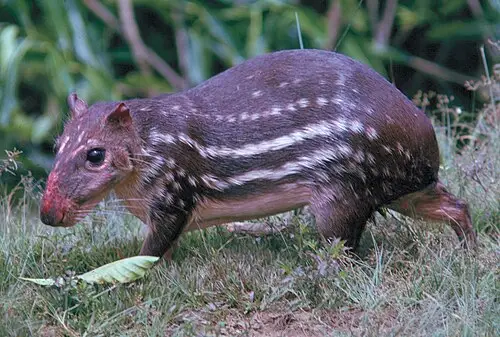
Photo: Garst, Warren, 1922-2016, photographer · CC BY-SA 4.0 · Wikimedia Commons Source
Lowland Paca
Cuniculus paca (Lowland Paca · パカ)
💡 Everyday Comparisons for Size, Mass & Speed
- 💡 An important game animal in its range, an average 10 kg individual yields about 70%, or around 7 kg, of edible meat.
- 💡 It prefers energy-rich fruits such as mangoes and avocados.
- 💡 Its maximum weight of 12 kg is slightly heavier than a 10 kg bag of rice (Comparison).
Reference standards: coach bus ~12 m, mid-size car ~4.9 m, compact car ~1 t, basketball hoop 3.05 m, credit card 8.56 cm.
Site-computed relative index from recorded values; not a formal scientific metric.
📖 1. Overview
The Lowland Paca is a large rodent living in tropical forests that forages for fallen fruits at night.
🦴 2. Anatomy & Morphology
Its reddish-brown to dark brown body has rows of white spots along both sides and almost no tail. With short legs and a large, blunt head, it is clumsy on land but swims well.
🔍 3. Ecology & Behavior
It sleeps in burrows or hollow logs during the day and is active at night, feeding mainly on fallen fruits. Pairs usually stay together long-term and produce one or two young year-round.
🇰🇷 4. Connection to Korea
No direct record connecting this species to Korea has been found.
📚 Sources & References
- • IUCN Red List LC (2016) — https://www.iucnredlist.org/species/699/22197347
- • IUCN Red List category LC — latest assessment at iucnredlist.org
- • mammaldiversity.org — 1001213
- • iucnredlist.org — 22197347
- • wikidata.org — Q33936
- • commons.wikimedia.org — File:Paca walking in grass close up - DPLA - 826590946052c72
- • animaldiversity.org — Cuniculus paca
- • Silhouette: PhyloPic — Margot Michaud · CC0 1.0
Recorded dimensions are widely cited representative estimates from public literature and may vary by study or specimen.