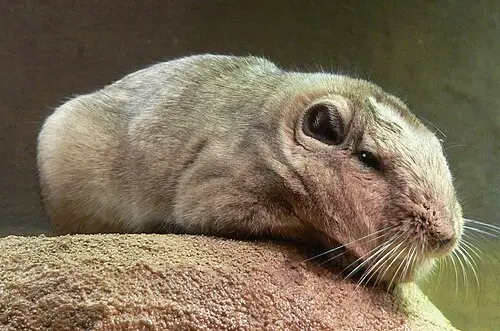
 📸 Photo
Photo: Public domain · Public domain · Wikimedia Commons Source
Common Gundi
Ctenodactylus gundi (Common Gundi · アトラスグンディ)
💡 Everyday Comparisons for Size, Mass & Speed
- 💡 Some Arabian tribes hunt the Common Gundi at dusk for food.
- 💡 Its maximum head-and-body length of 20 cm is slightly longer than a new pencil (about 17.5 cm) (Comparison).
- 💡 Its maximum weight of 195 g is similar to the weight of one apple (about 200 g) (Comparison).
Reference standards: coach bus ~12 m, mid-size car ~4.9 m, compact car ~1 t, basketball hoop 3.05 m, credit card 8.56 cm.
Site-computed relative index from recorded values; not a formal scientific metric.
📖 1. Overview
The Common Gundi is a small rodent living in the rocky deserts of North Africa with a plump body resembling a guinea pig.
🦴 2. Anatomy & Morphology
It has very short legs, flat ears, large eyes, and long whiskers. Its tail is just a wisp of hair 10–20 mm long, and the two inner toes of its hind feet have comb-like stiff bristles.
🔍 3. Ecology & Behavior
It lives in colonies in rock crevices and eats leaves, stalks, flowers, and seeds, traveling up to 1 km each morning because it does not store food. After about 40 days of gestation, females usually give birth to two young, which are weaned in 4 weeks.
🇰🇷 4. Connection to Korea
No direct record connecting this species to Korea has been found.
📚 Sources & References
- • IUCN Red List LC (2022) — https://www.iucnredlist.org/species/5792/22191625
- • IUCN Red List category LC — latest assessment at iucnredlist.org
- • mammaldiversity.org — 1001184
- • iucnredlist.org — 22191625
- • wikidata.org — Q1028802
- • commons.wikimedia.org — File:Gundi Ctenodactylus gundi 051117 2.jpg
- • animaldiversity.org — Ctenodactylus gundi
Recorded dimensions are widely cited representative estimates from public literature and may vary by study or specimen.