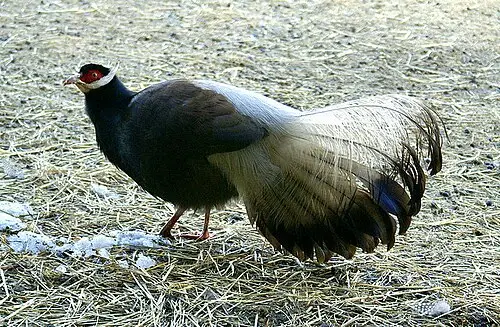
 📸 Photo
Photo: Somongkol Teng from Minneapolis, United States of America · CC BY 2.0 · Wikimedia Commons Source
Brown Eared Pheasant
Crossoptilon mantchuricum (Brown Eared Pheasant · ミミキジ)
💡 Everyday Comparisons for Size, Mass & Speed
- 💡 Its maximum body length of 100 cm is about adult waist height, and its maximum mass of 2.5 kg is about one 2 L bottle and one 0.5 L bottle of water combined (Comparison).
- 💡 Aviaries in several countries breed and display this bird and its close relatives (ADW, 'Economic Importance for Humans: Positive').
Reference standards: coach bus ~12 m, mid-size car ~4.9 m, compact car ~1 t, basketball hoop 3.05 m, credit card 8.56 cm.
Site-computed relative index from recorded values; not a formal scientific metric.
📖 1. Overview
The brown eared pheasant is a large pheasant living in mountain mixed coniferous and broadleaf forests. It forms flocks of 10–30 birds and is also kept in aviaries in many parts of the world.
🦴 2. Anatomy & Morphology
Reaching up to 100 cm in body length, males are dark brown on the head, neck, and upper chest, with long cream-to-whitish tail feathers ending in glossy purplish-blue brownish-black. Females are smaller and lack leg spurs.
🔍 3. Ecology & Behavior
An omnivore, it searches the ground for insects, seeds, and grasses and digs around grass clumps for underground plant parts such as bulbs and roots. Each day it leaves its forest roosts for grassy meadows and returns in the evening, and it is not aggressive even during the breeding season.
🇰🇷 4. Connection to Korea
No direct record connecting this species to Korea has been found.
📚 Sources & References
- • IUCN Red List LC (2024) — https://www.iucnredlist.org/species/22679299/254340969
- • IUCN Red List category LC — latest assessment at iucnredlist.org
- • doi.org — avilist.v2026
- • iucnredlist.org — 254340969
- • wikidata.org — Q790606
- • commons.wikimedia.org — File:Crossoptilon mantchuricum -USA -captive-8a.jpg
- • animaldiversity.org — Crossoptilon mantchuricum
- • Silhouette: PhyloPic — painting Guo · CC BY 4.0
Recorded dimensions are widely cited representative estimates from public literature and may vary by study or specimen.