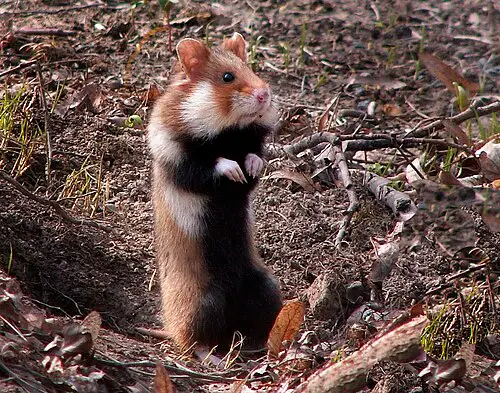
 📸 Photo
Photo: katanski · CC BY 3.0 · Wikimedia Commons Source
Common Hamster
Cricetus cricetus (Common Hamster · クロハラハムスター)
💡 Everyday Comparisons for Size, Mass & Speed
- 💡 Its maximum weight of 451 g is about one 500 mL bottle of water (about 0.5 kg), and its length of 24.1 cm is slightly longer than the short side of A4 paper (21 cm) (Comparison).
- 💡 Its winter burrow depth of 2 m is similar to the height of a tall adult human (Comparison). Because it also inhabits urban green spaces where it is exposed to pesticides and air pollution, it has been studied in cancer research (Animal Diversity Web).
Reference standards: coach bus ~12 m, mid-size car ~4.9 m, compact car ~1 t, basketball hoop 3.05 m, credit card 8.56 cm.
Site-computed relative index from recorded values; not a formal scientific metric.
📖 1. Overview
The Common Hamster is a stocky hamster living in grasslands and farmland of Europe, notable for its black belly and now classified as Critically Endangered.
🦴 2. Anatomy & Morphology
Its back and flanks are reddish-brown to grayish-brown, its snout, lips, throat, cheeks, and feet are white, and its belly is black. It has large dark eyes and straight, stiff whiskers.
🔍 3. Ecology & Behavior
Solitary and nocturnal, it eats grasses, seeds, grains, roots, fruits, and legumes, and occasionally insects. It hibernates from mid-October to mid-March in winter burrows reaching up to 2 m underground.
🇰🇷 4. Connection to Korea
No direct record connecting this species to Korea has been found.
📚 Sources & References
- • IUCN Red List CR (2020) — https://www.iucnredlist.org/species/5529/111875852
- • IUCN Red List category CR — latest assessment at iucnredlist.org
- • mammaldiversity.org — 1002207
- • iucnredlist.org — 111875852
- • wikidata.org — Q208077
- • commons.wikimedia.org — File:European hamster in Vienna.jpg
- • animaldiversity.org — Cricetus cricetus
- • Silhouette: PhyloPic — Edwin Price · CC0 1.0 (Related taxon silhouette — Oligoryzomys nigripes)
Recorded dimensions are widely cited representative estimates from public literature and may vary by study or specimen.