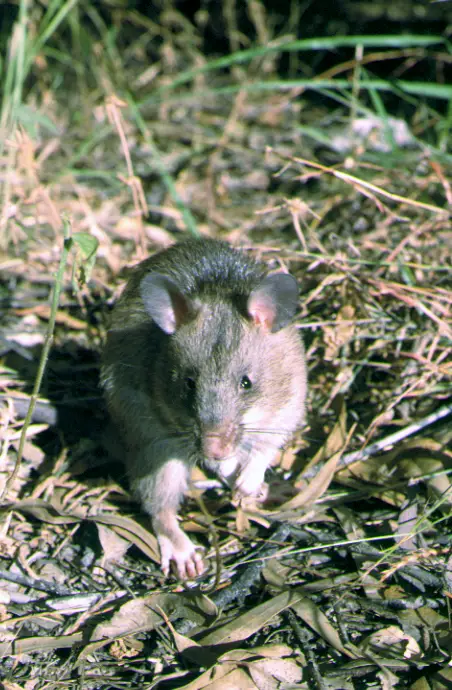
 📸 Photo
Photo: derekkeats · CC BY-SA 2.0 · Wikimedia Commons Source
Northern Giant Pouched Rat
Cricetomys gambianus (Northern Giant Pouched Rat · サバンナアフリカオニネズミ)
💡 Everyday Comparisons for Size, Mass & Speed
- 💡 Its maximum weight of 1.47 kg is about one and a half 1 kg bags of rice, and its length of 91 cm nearly reaches a 1 m tape measure (Comparison).
- 💡 In Africa it is hunted and farmed for its tasty meat, and it is also used in the small-scale pet trade and in physiological and behavioral research (Animal Diversity Web).
Reference standards: coach bus ~12 m, mid-size car ~4.9 m, compact car ~1 t, basketball hoop 3.05 m, credit card 8.56 cm.
Site-computed relative index from recorded values; not a formal scientific metric.
📖 1. Overview
The Northern Giant Pouched Rat is a very large African rodent famous for stuffing its cheek pouches full of food to carry away.
🦴 2. Anatomy & Morphology
It has coarse brown fur with dark rings around its small eyes, a narrow head, and a long scaly tail. Its cheek pouches can stretch to a very large size.
🔍 3. Ecology & Behavior
At night it eats fruits, vegetables, nuts, cassava, sweet potatoes, insects, termites, and snails, and has a habit of hoarding food. Sensitive to heat, it rests during the day in underground tunnels or hollow trees.
🇰🇷 4. Connection to Korea
No direct record connecting this species to Korea has been found.
📚 Sources & References
- • IUCN Red List LC (2023) — https://www.iucnredlist.org/species/112169507/243173564
- • IUCN Red List category LC — latest assessment at iucnredlist.org
- • mammaldiversity.org — 1003706
- • iucnredlist.org — 243173564
- • wikidata.org — Q1770542
- • commons.wikimedia.org — File:Afr-giant-rat.jpg
- • animaldiversity.org — Cricetomys gambianus
- • Silhouette: PhyloPic — Ferran Sayol · CC0 1.0 (Related taxon silhouette — Nesomyidae)
Recorded dimensions are widely cited representative estimates from public literature and may vary by study or specimen.