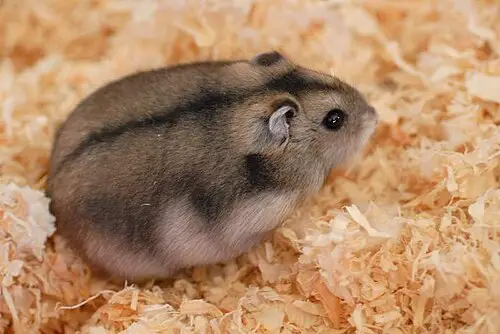
 📸 Photo
Photo: Philipp Salzgeber · CC BY 2.5 · Wikimedia Commons Source
Siberian Hairy-footed Hamster
Cricetiscus sungorus (Siberian Hairy-footed Hamster · Siberian Hairy-footed Hamster)
Not Evaluated (NE) on the IUCN Red List yet.
💡 Everyday Comparisons for Size, Mass & Speed
- 💡 Its maximum head-and-body length of 9 cm is similar to the width of a credit card (about 8.6 cm) (Comparison).
- 💡 A weight of 22–25 g is just over the weight of three Korean 500-won coins (7.7 g each) (Comparison).
- 💡 Because its coat turns white in winter, handbooks also list the common name 'Russian Winter White Dwarf Hamster.'
Reference standards: coach bus ~12 m, mid-size car ~4.9 m, compact car ~1 t, basketball hoop 3.05 m, credit card 8.56 cm.
Site-computed relative index from recorded values; not a formal scientific metric.
📖 1. Overview
The Siberian Hairy-footed Hamster is a tiny hamster living in the steppes and semi-deserts of southwestern Siberia and Kazakhstan whose fur turns white in winter.
🦴 2. Anatomy & Morphology
Its body is plump and its feet are short and wide. Its summer coat is ash-gray to dark brown with a black stripe from head to base of tail, while its winter coat is white with only the dorsal stripe remaining dark gray.
🔍 3. Ecology & Behavior
Active mainly at night, it eats grass seeds and green plant parts, and rarely insects. It stores food in chambers inside its burrow and produces 3–6 litters per year between spring and autumn after a gestation period of about 18 days.
🇰🇷 4. Connection to Korea
No direct record connecting this species to Korea has been found.
📚 Sources & References
- • IUCN Red List: not evaluated (NE) — cross-checked with the Wikidata conservation-status entry
- • mammaldiversity.org — 1002215
- • wikidata.org — Q141707391
- • zenodo.org — 6706432
- • doi.org — 0.595.1
- • Silhouette: PhyloPic — Edwin Price · CC0 1.0 (Related taxon silhouette — Oligoryzomys nigripes)
Recorded dimensions are widely cited representative estimates from public literature and may vary by study or specimen.