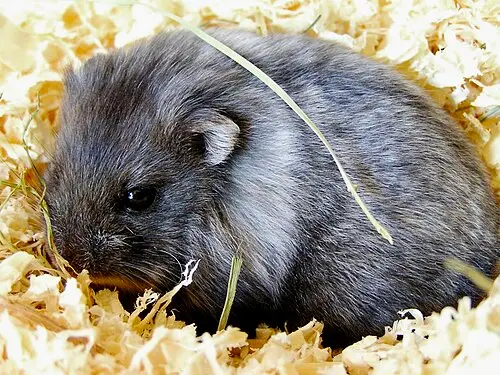
 📸 Photo
Photo: NasserHalaweh · CC BY-SA 4.0 · Wikimedia Commons Source
Mongolian Hairy-footed Hamster
Cricetiscus campbelli (Mongolian Hairy-footed Hamster · ドワーフハムスター)
Not Evaluated (NE) on the IUCN Red List yet.
💡 Everyday Comparisons for Size, Mass & Speed
- 💡 Its average weight of 23.4 g is about the same as three Korean 500-won coins (about 7.7 g each), and its top running speed of 6.5 km/h is slightly faster than a brisk human walk (about 5 km/h) (Comparison).
- 💡 Introduced to the US pet market in the mid-1990s under the name 'dwarf hamster,' it is popular for its small size, gentle nature, and low upkeep cost, and is also used in cytogenetics and cancer research (Animal Diversity Web).
Reference standards: coach bus ~12 m, mid-size car ~4.9 m, compact car ~1 t, basketball hoop 3.05 m, credit card 8.56 cm.
Site-computed relative index from recorded values; not a formal scientific metric.
📖 1. Overview
The Mongolian Hairy-footed Hamster is a tiny hamster living in burrows in the steppes and deserts of Mongolia and northeastern China. Its former scientific name is Phodopus campbelli.
🦴 2. Anatomy & Morphology
Its body is very small with short, silky fur that is wood-brown on the back. Males are larger than females.
🔍 3. Ecology & Behavior
In the wild, it eats various seeds, nuts, and plants, storing food in its burrow. It is a mostly solitary, nocturnal, burrowing animal.
🇰🇷 4. Connection to Korea
No direct record connecting this species to Korea has been found.
📚 Sources & References
- • IUCN Red List: not evaluated (NE) — cross-checked with the Wikidata conservation-status entry
- • mammaldiversity.org — 1002213
- • wikidata.org — Q738140
- • animaldiversity.org — Phodopus campbelli
- • Silhouette: PhyloPic — Edwin Price · CC0 1.0 (Related taxon silhouette — Oligoryzomys nigripes)
Recorded dimensions are widely cited representative estimates from public literature and may vary by study or specimen.