 📸 Photo
Photo: (c) Kim, Hyun-tae, some rights reserved (CC BY) · CC BY 4.0 · Wikimedia Commons Source
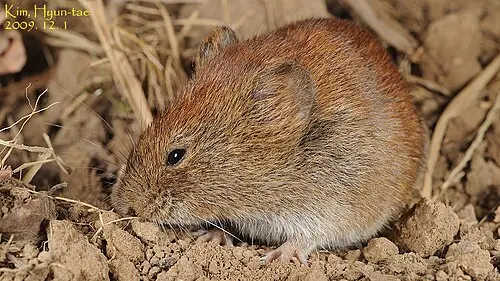
Korean Red-backed Vole
Craseomys regulus (Korean Red-backed Vole · Korean Red-backed Vole)
💡 Everyday Comparisons for Size, Mass & Speed
- 💡 Its maximum weight of 29 g is close to four Korean 500-won coins (about 7.7 g each), and its combined head-body and tail length of 16 cm is similar to the length of a smartphone (about 15 cm) (Comparison).
- 💡 Having diverged as a distinct endemic species south of the Gaema Plateau, this vole inhabits mountains, farmland, and riverbanks in Korea (National List of Species of Korea).
Reference standards: coach bus ~12 m, mid-size car ~4.9 m, compact car ~1 t, basketball hoop 3.05 m, credit card 8.56 cm.
Site-computed relative index from recorded values; not a formal scientific metric.
📖 1. Overview
The Korean Red-backed Vole is a species endemic to Korea, living in underground burrows in mountains, fields, and riverbanks south of the Gaema Plateau.
🦴 2. Anatomy & Morphology
Its back is reddish and its sides are grayish, while its tail is dark brown above and grayish-white below. Its molars are rootless.
🔍 3. Ecology & Behavior
It comes out at night to eat grass, seeds, and other plants. It breeds 3–5 times a year, giving birth to 3–5 young per litter after a gestation period of 23 days.
🇰🇷 4. Connection to Korea
It is an endemic species of Korea listed as 'Daeryuk-batjwi' (Korean name) on the National List of Species of Korea. It is distributed throughout the country south of the Gaema Plateau, excluding Jeju Island.
📚 Sources & References
- • IUCN Red List LC (2016) — https://www.iucnredlist.org/species/7804/115086900
- • IUCN Red List category LC — latest assessment at iucnredlist.org
- • mammaldiversity.org — 1002168
- • iucnredlist.org — 115086900
- • 국가생물종목록(국립생물자원관) ktsn 120000053451 — https://species.nibr.go.kr/home/mainHome.do?cont_link=009&subMenu=009002&contCd=009002&ktsn=120000053451
- • wikidata.org — Q125906184
- • commons.wikimedia.org — File:Korean Red-backed Vole imported from iNaturalist photo
- • species.nibr.go.kr — mainHome.do
- • Silhouette: PhyloPic — Edwin Price · CC0 1.0 (Related taxon silhouette — Oligoryzomys nigripes)
Recorded dimensions are widely cited representative estimates from public literature and may vary by study or specimen.