 📸 Photo
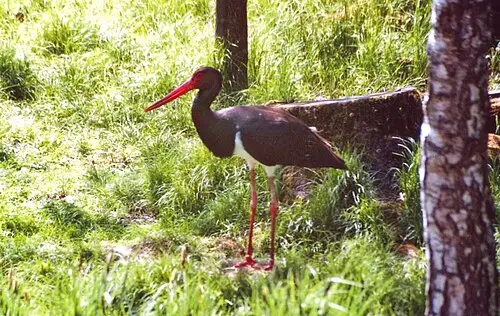
Photo: J. Patrick Fischer · CC BY-SA 2.5 · Wikimedia Commons Source
Black Stork
Ciconia nigra (Black Stork · ナベコウ)
🇰🇷 Class I endangered wildlife (Korea) · Natural Monument (Korea) «Black Stork»
💡 Everyday Comparisons for Size, Mass & Speed
- 💡 Its mass of about 3 kg is around 30% of a 10 kg bag of rice (Comparison).
- 💡 Its wingspan of about 1.55 m is slightly narrower than an adult's outstretched arm span (about 1.7 m) (Comparison).
Reference standards: coach bus ~12 m, mid-size car ~4.9 m, compact car ~1 t, basketball hoop 3.05 m, credit card 8.56 cm.
Site-computed relative index from recorded values; not a formal scientific metric.
📖 1. Overview
The black stork is a dark stork that breeds across the Palearctic from Spain to China and migrates south in autumn to winter in southern Africa and India. On the IUCN Red List, it is of Least Concern (LC).
🦴 2. Anatomy & Morphology
Its body length is 95–100 cm, its mass is about 3 kg, and its wingspan is 144–155 cm, with males larger than females.
🔍 3. Ecology & Behavior
It hunts by sight for frogs, salamanders, eels, small reptiles, fish, and occasionally small mammals, with fish making up most of its diet during the breeding season. It lays 3–5 eggs from late April (month 4) to May (month 5), which hatch in 32–38 days.
🇰🇷 4. Connection to Korea
In Korea, it is a Class I endangered wildlife (Korea) species and was designated a Natural Monument (Korea) on May 31, 1968 (1968-05-31).
📚 Sources & References
- • IUCN Red List LC (2025) — https://www.iucnredlist.org/species/22697669/281840802
- • 멸종위기 야생생물 Ⅰ급 · 천연기념물 «먹황새» — 국가생물종목록(국립생물자원관) ktsn 120000001510 — https://species.nibr.go.kr/home/mainHome.do?cont_link=009&subMenu=009002&contCd=009002&ktsn=120000001510
- • IUCN Red List category LC — latest assessment at iucnredlist.org
- • Korean protection status: Class I endangered wildlife (Korea) · Natural Monument (Korea) «Black Stork»
- • doi.org — avilist.v2026
- • iucnredlist.org — 281840802
- • 국가생물종목록(국립생물자원관) ktsn 120000001510 — https://species.nibr.go.kr/home/mainHome.do?cont_link=009&subMenu=009002&contCd=009002&ktsn=120000001510
- • heritage.go.kr — culSelectDetail.do
- • wikidata.org — Q25398
- • commons.wikimedia.org — File:Ciconia nigra.jpg
- • avifauna.hkbws.org.hk — 020600
- • animaldiversity.org — Ciconia nigra
- • Silhouette: PhyloPic — Andy Wilson · CC0 1.0
Recorded dimensions are widely cited representative estimates from public literature and may vary by study or specimen.