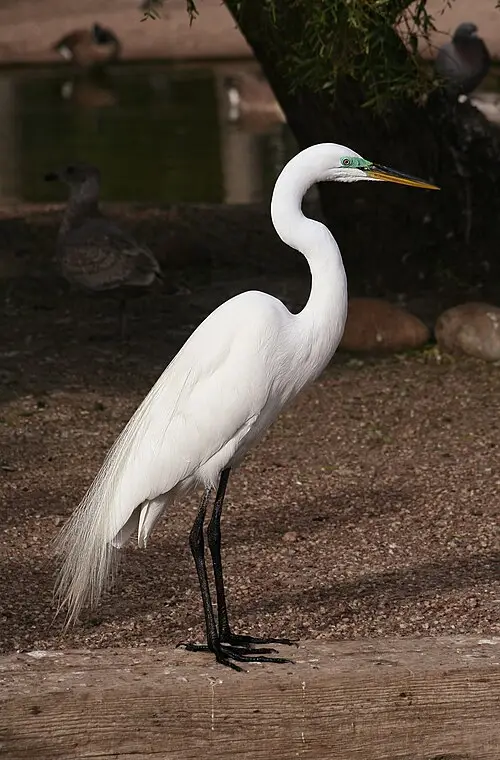
 📸 Photo
Photo: Calibas · CC BY-SA 3.0 · Wikimedia Commons Source
Great Egret
Ardea alba (Great Egret · ダイサギ)
💡 Everyday Comparisons for Size, Mass & Speed
- 💡 Its body length of about 90 cm is similar to a full-size umbrella (about 80–90 cm).
- 💡 The tall white bird seen standing motionless along summer rice paddies, streams, and fish-farm edges waiting for prey is the Great Egret (National List of Species of Korea).
- 💡 Before the 20th century, it was heavily hunted for its lacy breeding plumes, which were prized for decorating women's hats (Animal Diversity Web).
Reference standards: coach bus ~12 m, mid-size car ~4.9 m, compact car ~1 t, basketball hoop 3.05 m, credit card 8.56 cm.
Site-computed relative index from recorded values; not a formal scientific metric.
📖 1. Overview
The Great Egret is a large, all-white egret with a long bill and long legs. In Korea, it is a common summer visitor that breeds throughout the country.
🦴 2. Anatomy & Morphology
During the breeding season, the bill turns black, the lores become bluish-green, and lacy ornamental plumes grow on the back. After breeding, the bill turns yellow and the plumes are shed.
🔍 3. Ecology & Behavior
It walks slowly through rice paddies, streams, and tidal flats to catch prey such as fish and frogs. Nesting colonially with other herons and egrets, it lays 3–4 eggs and incubates them for 25–28 days.
🇰🇷 4. Connection to Korea
It is a common summer visitor breeding nationwide and is occasionally seen in winter; the larger subspecies winters in Korea.
📚 Sources & References
- • IUCN Red List LC (2025) — https://www.iucnredlist.org/species/22697043/280949218
- • IUCN Red List category LC — latest assessment at iucnredlist.org
- • doi.org — avilist.v2026
- • iucnredlist.org — 280949218
- • 국가생물종목록(국립생물자원관) ktsn 120000001543 — https://species.nibr.go.kr/home/mainHome.do?cont_link=009&subMenu=009002&contCd=009002&ktsn=120000001543
- • wikidata.org — Q130730
- • commons.wikimedia.org — File:Ardea alba4.jpg
- • species.nibr.go.kr — mainHome.do
- • animaldiversity.org — Ardea alba
- • Silhouette: PhyloPic — Caleb M. Gordon · CC0 1.0
Recorded dimensions are widely cited representative estimates from public literature and may vary by study or specimen.