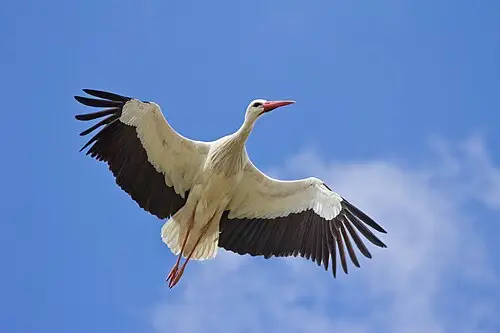
 📸 Photo
Photo: Carlos Delgado · CC BY-SA 3.0 · Wikimedia Commons Source
White Stork
Ciconia ciconia (White Stork · シュバシコウ)
💡 Everyday Comparisons for Size, Mass & Speed
- 💡 Its average mass of 8 kg is the weight of one medium-sized 8 kg bag of rice (Comparison).
- 💡 By nesting on rooftops, chimneys, and tall trees, it has long lived close to human homes (Animal Diversity Web).
- 💡 It helps farming by eating crop pests such as locusts and grasshoppers (Animal Diversity Web).
Reference standards: coach bus ~12 m, mid-size car ~4.9 m, compact car ~1 t, basketball hoop 3.05 m, credit card 8.56 cm.
Site-computed relative index from recorded values; not a formal scientific metric.
📖 1. Overview
The white stork is a large wading bird that is white all over except for black wingtips. It lives in open wetlands, grasslands, and farmlands, staying close to human settlements.
🦴 2. Anatomy & Morphology
Its plumage is white with black primary wing feathers. Its bill is long and pointed, and its slender legs are bright orange.
🔍 3. Ecology & Behavior
It walks along searching for insects, frogs, fish, voles, and snakes, snatching them up with its bill. In spring, the male returns first to enlarge the previous year's nest, and when the female arrives they cement their pair bond with a head-shaking display.
🇰🇷 4. Connection to Korea
No direct record connecting this species to Korea has been found.
📚 Sources & References
- • IUCN Red List LC (2025) — https://www.iucnredlist.org/species/22697691/281839847
- • IUCN Red List category LC — latest assessment at iucnredlist.org
- • doi.org — avilist.v2026
- • iucnredlist.org — 281839847
- • wikidata.org — Q25352
- • commons.wikimedia.org — File:Ciconia ciconia - 01.jpg
- • animaldiversity.org — Ciconia ciconia
- • Silhouette: PhyloPic — Mathieu Pélissié · CC BY 4.0
Recorded dimensions are widely cited representative estimates from public literature and may vary by study or specimen.