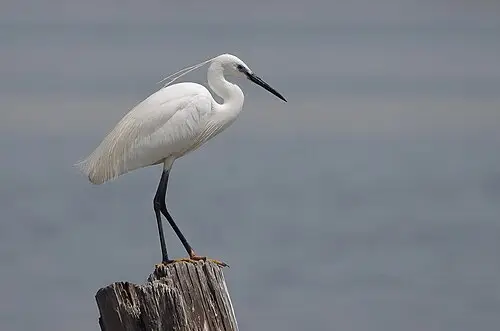
 📸 Photo
Photo: El Golli Mohamed · CC BY-SA 4.0 · Wikimedia Commons Source
Little Egret
Egretta garzetta (Little Egret · コサギ)
💡 Everyday Comparisons for Size, Mass & Speed
- 💡 Its body length of about 60 cm is around twice the long side of an A4 sheet of paper (29.7 cm) (Comparison).
- 💡 This small white bird can be seen almost anywhere walking along shallow edges of rice paddies and streams in search of fish and frogs (National List of Species of Korea).
- 💡 In summer, it gathers in the same woods with Jungdaebaengno, Hwangno, and Waegari (Korean animal names) to form breeding colonies (National List of Species of Korea).
Reference standards: coach bus ~12 m, mid-size car ~4.9 m, compact car ~1 t, basketball hoop 3.05 m, credit card 8.56 cm.
📖 1. Overview
The little egret is the smallest of the white egrets. It is distributed across China, Japan, Southeast Asia, India, Australia, and New Guinea.
🦴 2. Anatomy & Morphology
Its plumage is uniformly white, and two long white ornamental plumes grow from the upper neck. Its bill and legs are black, and its feet are yellow.
🔍 3. Ecology & Behavior
Along shallow waters it hunts fish, frogs, snakes, shrimp, crayfish, and aquatic insects using a variety of methods. From late April (month 4) to early August (month 8), it breeds in mixed colonies with Jungdaebaengno (a Korean animal name), Hwangno (a Korean animal name), and Waegari (a Korean animal name), laying 3–5 eggs and incubating them for 22–24 days.
🇰🇷 4. Connection to Korea
It is a common summer visitor that is also observed in many areas during winter, with some individuals staying year-round as residents.
📚 Sources & References
- • IUCN Red List LC (2025) — https://www.iucnredlist.org/species/62774969/154819214
- • IUCN Red List category LC — latest assessment at iucnredlist.org
- • doi.org — avilist.v2026
- • iucnredlist.org — 154819214
- • 국가생물종목록(국립생물자원관) ktsn 120000001546 — https://species.nibr.go.kr/home/mainHome.do?cont_link=009&subMenu=009002&contCd=009002&ktsn=120000001546
- • wikidata.org — Q131709
- • commons.wikimedia.org — File:Aigrette garzette au lac sud de Tunis (site RAMSAR).jpg
- • species.nibr.go.kr — mainHome.do
- • Silhouette: PhyloPic — Matej Frantisek Calfa · CC BY 4.0
Recorded dimensions are widely cited representative estimates from public literature and may vary by study or specimen.