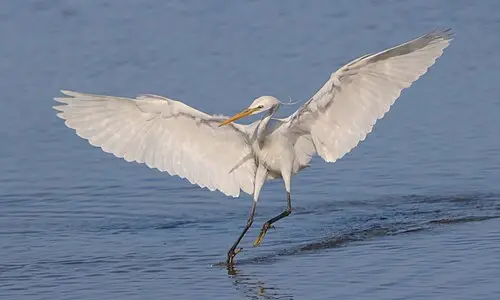
 📸 Photo
Photo: YCCHEN TW · CC BY-SA 4.0 · Wikimedia Commons Source
Chinese Egret
Egretta eulophotes (Chinese Egret · カラシラサギ)
🇰🇷 Class I endangered wildlife (Korea) · Natural Monument (Korea) «Chinese Egret»
💡 Everyday Comparisons for Size, Mass & Speed
- 💡 Its mass of about 0.54 kg is similar to one 500 mL bottle of water (0.5 kg) (Comparison).
- 💡 Its body length of about 68 cm is around 80% of the length of a baseball bat (about 84 cm) (Comparison).
Reference standards: coach bus ~12 m, mid-size car ~4.9 m, compact car ~1 t, basketball hoop 3.05 m, credit card 8.56 cm.
Site-computed relative index from recorded values; not a formal scientific metric.
📖 1. Overview
The Chinese egret is an egret distributed along the East Asian coast from eastern Russia through China to the Philippines and Indonesia, breeding in colonies on offshore islands. On the IUCN Red List, it is Vulnerable (VU).
🦴 2. Anatomy & Morphology
Its body length is 65–68 cm and its mass is 390–540 g.
🔍 3. Ecology & Behavior
In shallow water it mainly eats small fish and shrimp along with crabs and insects. In May (month 5), it nests in colonies in trees, low shrubs, or on rocks on islands and usually lays 3–4 eggs.
🇰🇷 4. Connection to Korea
In Korea, it is a Class I endangered wildlife (Korea) species and was designated a Natural Monument (Korea) on August 23, 1988 (1988-08-23). Heron Specialist Group materials note breeding sites on islands off the west coast of Korea (historical count).
📚 Sources & References
- • IUCN Red List VU (2025) — https://www.iucnredlist.org/species/22696977/154698211
- • 멸종위기 야생생물 Ⅰ급 · 천연기념물 «노랑부리백로» — 국가생물종목록(국립생물자원관) ktsn 120000001548 — https://species.nibr.go.kr/home/mainHome.do?cont_link=009&subMenu=009002&contCd=009002&ktsn=120000001548
- • IUCN Red List category VU — latest assessment at iucnredlist.org
- • Korean protection status: Class I endangered wildlife (Korea) · Natural Monument (Korea) «Chinese Egret»
- • doi.org — avilist.v2026
- • iucnredlist.org — 154698211
- • 국가생물종목록(국립생물자원관) ktsn 120000001548 — https://species.nibr.go.kr/home/mainHome.do?cont_link=009&subMenu=009002&contCd=009002&ktsn=120000001548
- • heritage.go.kr — culSelectDetail.do
- • wikidata.org — Q392152
- • commons.wikimedia.org — File:Zengwen River Mouth Wetlands Yi-Cheng, Chen 555594020 -
- • heronconservation.org — chinese-egret
- • Silhouette: PhyloPic — Matej Frantisek Calfa · CC BY 4.0 (Congeneric silhouette — Egretta garzetta)
Recorded dimensions are widely cited representative estimates from public literature and may vary by study or specimen.