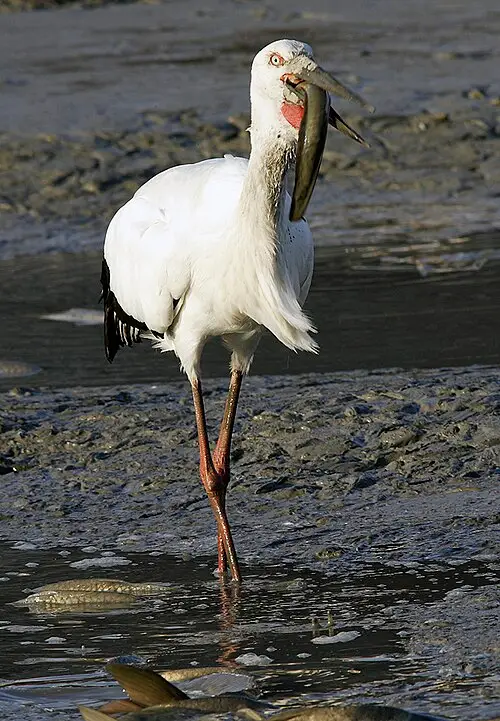
 📸 Photo
Photo: spaceaero2 · CC BY 3.0 · Wikimedia Commons Source
Oriental Stork
Ciconia boyciana (Oriental Stork · コウノトリ)
🇰🇷 Class I endangered wildlife (Korea) · Natural Monument (Korea) «Oriental Stork»
💡 Everyday Comparisons for Size, Mass & Speed
- 💡 Its body length of about 1.15 m is more than half the height of a standard door (about 2 m) (Comparison).
- 💡 In Japan, it is said to have nested on top of the roofs of large temples until the 1870s.
Reference standards: coach bus ~12 m, mid-size car ~4.9 m, compact car ~1 t, basketball hoop 3.05 m, credit card 8.56 cm.
📖 1. Overview
The Oriental stork is a large stork that breeds in northeastern China and the Ussuri region and moves south to southeastern China, Korea, and Japan for winter. On the IUCN Red List it is Endangered (EN), with a declining population of 1,000–2,499 mature individuals.
🦴 2. Anatomy & Morphology
It is a large bird with a body length of 110–115 cm.
🔍 3. Ecology & Behavior
In Japan, wild birds disappeared after the last wild individual was captured in 1971, but reintroduction began in 1992 and wild breeding has continued since 2007. Until the 1870s, it even nested on the roofs of large temples in eastern Japan.
🇰🇷 4. Connection to Korea
In Korea, it is a Class I endangered wildlife (Korea) species and was designated a Natural Monument (Korea) on May 31, 1968 (1968-05-31). The Hong Kong Bird Watching Society notes Korea as one of its wintering grounds.
📚 Sources & References
- • IUCN Red List EN (2018) — https://www.iucnredlist.org/species/22697695/131942061
- • 멸종위기 야생생물 Ⅰ급 · 천연기념물 «황새» — 국가생물종목록(국립생물자원관) ktsn 120000001511 — https://species.nibr.go.kr/home/mainHome.do?cont_link=009&subMenu=009002&contCd=009002&ktsn=120000001511
- • IUCN Red List category EN — latest assessment at iucnredlist.org
- • Korean protection status: Class I endangered wildlife (Korea) · Natural Monument (Korea) «Oriental Stork»
- • doi.org — avilist.v2026
- • iucnredlist.org — 131942061
- • 국가생물종목록(국립생물자원관) ktsn 120000001511 — https://species.nibr.go.kr/home/mainHome.do?cont_link=009&subMenu=009002&contCd=009002&ktsn=120000001511
- • heritage.go.kr — culSelectDetail.do
- • wikidata.org — Q998495
- • commons.wikimedia.org — File:Oriental Stork 2 marugame kagawa.jpg
- • avifauna.hkbws.org.hk — 020700
- • eaaflyway.org — oriental-stork
- • Silhouette: PhyloPic — Ferran Sayol · CC0 1.0 (Congeneric silhouette — Ciconia)
Recorded dimensions are widely cited representative estimates from public literature and may vary by study or specimen.