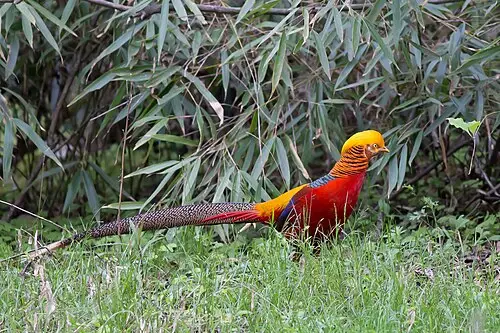
 📸 Photo
Photo: Jmhullot · CC BY 3.0 · Wikimedia Commons Source
Golden Pheasant
Chrysolophus pictus (Golden Pheasant · キンケイ)
💡 Everyday Comparisons for Size, Mass & Speed
- 💡 Its body length of 98 cm is almost the same as a 1 m ruler, and its mass of 625 g is about five packs of instant noodles (about 120 g per pack) (Comparison).
- 💡 In China, techniques for domesticating and breeding it are well established, but hunting for its beautiful feathers and for use in traditional medicine threatens wild populations.
- 💡 In the United Kingdom, birds released from ornamental collections once lived in the wild, but they have now almost disappeared.
Reference standards: coach bus ~12 m, mid-size car ~4.9 m, compact car ~1 t, basketball hoop 3.05 m, credit card 8.56 cm.
Site-computed relative index from recorded values; not a formal scientific metric.
📖 1. Overview
The golden pheasant is a pheasant species native only to the mountains of central China, resplendent with a red body and yellow crest. In China, it is a Class 2 state-protected animal.
🦴 2. Anatomy & Morphology
Its body is red, its back and legs are yellowish, its head bears a distinct crest, and its tail is wedge-shaped. Each leg has a single spur.
🔍 3. Ecology & Behavior
It walks about by day and at dawn and dusk eating grasses, seeds, fruits, and insects, and roosts in flocks in trees at night. It nests on the ground and lays 5–9 eggs that the female incubates for about 22 days, and one male mates with several females.
🇰🇷 4. Connection to Korea
No direct record connecting this species to Korea has been found.
📚 Sources & References
- • IUCN Red List LC (2018) — https://www.iucnredlist.org/species/22679355/131874282
- • IUCN Red List category LC — latest assessment at iucnredlist.org
- • doi.org — avilist.v2026
- • iucnredlist.org — 131874282
- • wikidata.org — Q335113
- • commons.wikimedia.org — File:Golden Pheasant, Tangjiahe Nature Reserve.jpg
- • museum.ioz.ac.cn — topic detail.aspx
- • bto.org — golden-pheasant
- • Silhouette: PhyloPic — author not recorded · Public Domain Mark 1.0 (Related taxon silhouette — Arborophila hyperythra)
Recorded dimensions are widely cited representative estimates from public literature and may vary by study or specimen.