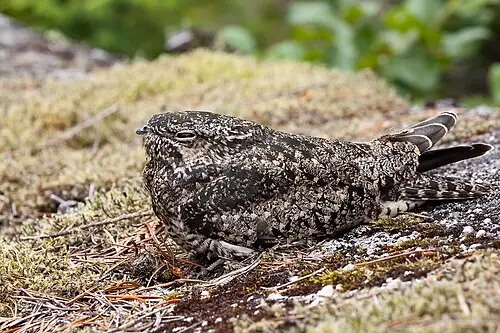
 📸 Photo
Photo: Gavin Keefe Schaefer · CC BY 2.0 · Wikimedia Commons Source
Common Nighthawk
Chordeiles minor (Common Nighthawk · アメリカヨタカ)
💡 Everyday Comparisons for Size, Mass & Speed
- 💡 Its maximum mass of 98 g is about two chicken eggs (one egg is about 50 g), and its body length of 24 cm is slightly longer than the short side of an A4 sheet of paper (21 cm) (Comparison).
- 💡 By flying over farmlands and cities to eat pest insects it is thought to be helpful to people, and in cities it also lays eggs on flat gravel roofs (Animal Diversity Web).
Reference standards: coach bus ~12 m, mid-size car ~4.9 m, compact car ~1 t, basketball hoop 3.05 m, credit card 8.56 cm.
Site-computed relative index from recorded values; not a formal scientific metric.
📖 1. Overview
The common nighthawk is a migratory bird in the nightjar family that breeds in North and Central America and migrates far south, catching flying insects at dusk and dawn.
🦴 2. Anatomy & Morphology
It has a large mouth and eyes, camouflaged plumage that blends into its surroundings, and long, pointed wings marked with white patches. A mirror-like layer (tapetum) behind the eye helps it see prey well in the dark.
🔍 3. Ecology & Behavior
It flies with its large mouth wide open to catch insects, and during the breeding season males court females by climbing high and diving steeply while air rushing through their feathers makes a booming sound. Traveling 4,000–11,000 km, it undertakes one of the longest migrations of any bird in the Americas.
🇰🇷 4. Connection to Korea
No direct record connecting this species to Korea has been found.
📚 Sources & References
- • IUCN Red List LC (2021) — https://www.iucnredlist.org/species/22689714/189010894
- • IUCN Red List category LC — latest assessment at iucnredlist.org
- • doi.org — avilist.v2026
- • iucnredlist.org — 189010894
- • wikidata.org — Q943329
- • commons.wikimedia.org — File:Chordeiles minor -British Columbia -Canada-8c.jpg
- • animaldiversity.org — Chordeiles minor
- • Silhouette: PhyloPic — Andy Wilson · CC0 1.0
Recorded dimensions are widely cited representative estimates from public literature and may vary by study or specimen.