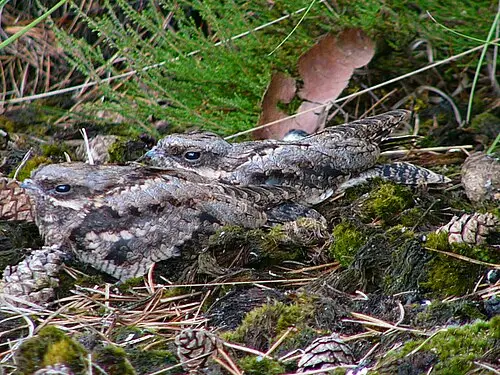
 📸 Photo
Photo: P.Taszynski · CC BY-SA 3.0 · Wikimedia Commons Source
European Nightjar
Caprimulgus europaeus (European Nightjar · ヨーロッパヨタカ)
💡 Everyday Comparisons for Size, Mass & Speed
- 💡 Its wingspan of 64 cm is longer than the width of a 24-inch monitor (about 53 cm), and its mass of 101 g is about two chicken eggs (Comparison).
- 💡 By eating large numbers of insects it can be helpful where insect pests abound, and Central Asian falconers in the past prized this erratically darting bird as quarry (Animal Diversity Web).
Reference standards: coach bus ~12 m, mid-size car ~4.9 m, compact car ~1 t, basketball hoop 3.05 m, credit card 8.56 cm.
Site-computed relative index from recorded values; not a formal scientific metric.
📖 1. Overview
The European nightjar is a nightjar that breeds in Europe and winters in Africa, catching flying insects at dusk and night over moors and clearings in woods.
🦴 2. Anatomy & Morphology
Its body has a complex mottled pattern of grey to reddish-brown, making it nearly invisible when resting on the ground or a branch by day. Its long, pointed wings and tail give it a falcon-like silhouette, and stiff bristles surround its wide mouth and bill.
🔍 3. Ecology & Behavior
Active at dusk and night, it snatches insects such as moths, beetles, and dragonflies in its wide mouth. It breeds from May to September (months 5–9), and males fiercely fight rival males in the air or on the ground over breeding territories.
🇰🇷 4. Connection to Korea
No direct record connecting this species to Korea has been found.
📚 Sources & References
- • IUCN Red List LC (2025) — https://www.iucnredlist.org/species/22689887/281014252
- • IUCN Red List category LC — latest assessment at iucnredlist.org
- • doi.org — avilist.v2026
- • iucnredlist.org — 281014252
- • wikidata.org — Q26717
- • commons.wikimedia.org — File:Caprimulgus europaeus g.JPG
- • animaldiversity.org — Caprimulgus europaeus
- • Silhouette: PhyloPic — Ferran Sayol · CC0 1.0 (Congeneric silhouette — Caprimulgus)
Recorded dimensions are widely cited representative estimates from public literature and may vary by study or specimen.