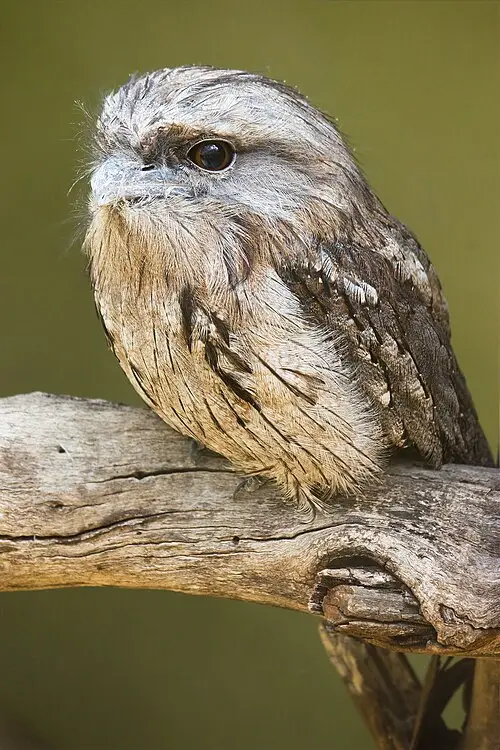
 📸 Photo
Photo: JJ Harrison ( https://www.jjharrison.com.au/ ) · CC BY-SA 3.0 · Wikimedia Commons Source
Tawny Frogmouth
Podargus strigoides (Tawny Frogmouth · オーストラリアガマグチヨタカ)
💡 Everyday Comparisons for Size, Mass & Speed
- 💡 Its maximum body length of 53 cm is about two and a half times the diameter of a soccer ball (about 22 cm) (Comparison).
- 💡 At night, it is often hit by cars while chasing insects drawn to automobile headlights (Australian Museum).
Reference standards: coach bus ~12 m, mid-size car ~4.9 m, compact car ~1 t, basketball hoop 3.05 m, credit card 8.56 cm.
📖 1. Overview
The Tawny Frogmouth is a nocturnal bird living across mainland Australia and Tasmania that perches on tree branches during the day and looks like part of the tree.
🦴 2. Anatomy & Morphology
It has camouflaged plumage that makes it look like part of a tree when perched against a branch by day. Its body length is 34–53 cm, with southeastern individuals larger than northern ones.
🔍 3. Ecology & Behavior
At night it eats mainly insects, earthworms, slugs, and snails, and also takes small mammals, reptiles, frogs, and birds. From August to December, it lays 2–3 eggs in a loose stick nest in a tree fork, which both parents incubate together.
🇰🇷 4. Connection to Korea
No direct record connecting this species to Korea has been found.
📚 Sources & References
- • IUCN Red List LC (2024) — https://www.iucnredlist.org/species/22689580/253969296
- • IUCN Red List category LC — latest assessment at iucnredlist.org
- • doi.org — avilist.v2026
- • iucnredlist.org — 253969296
- • wikidata.org — Q788512
- • commons.wikimedia.org — File:Podargus strigoides Bonorong.jpg
- • australian.museum — tawny-frogmouth
- • birdsinbackyards.net — Podargus-strigoides
- • Silhouette: PhyloPic — Matt Wilkins · CC0 1.0
Recorded dimensions are widely cited representative estimates from public literature and may vary by study or specimen.