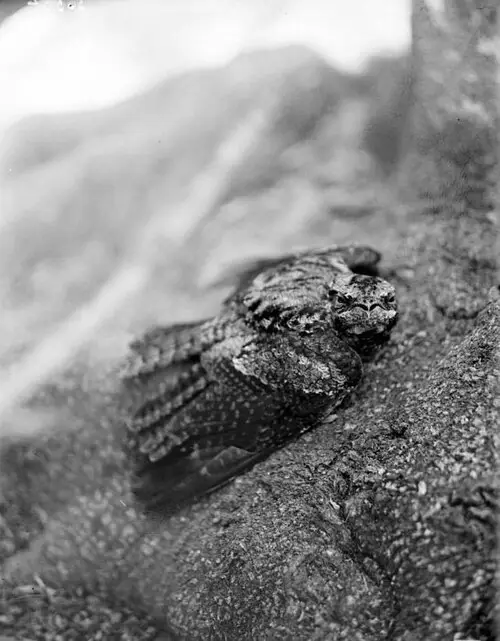
 📸 Photo
Photo: Unknown author Unknown author · CC BY-SA 3.0 · Wikimedia Commons Source
Grey Nightjar
Caprimulgus jotaka (Grey Nightjar · ヨタカ)
💡 Everyday Comparisons for Size, Mass & Speed
- 💡 Because it is almost invisible in the woods by day, people tell where it is from its 'ssok-ssok' call (Encyclopedia of Korean Culture).
- 💡 Its body length of about 29 cm is virtually the same as the long side of an A4 sheet of paper (29.7 cm) (Comparison).
Reference standards: coach bus ~12 m, mid-size car ~4.9 m, compact car ~1 t, basketball hoop 3.05 m, credit card 8.56 cm.
📖 1. Overview
The grey nightjar is a common summer visitor found across Korea that is active at night. Split from C. indicus, its Korean name comes from its 'ssok-ssok' call.
🦴 2. Anatomy & Morphology
Its camouflage is so effective that by day it is hard to spot in dark woods or on leafy branches. Its wing length is 214–217 mm.
🔍 3. Ecology & Behavior
The breeding season runs from May to August (months 5–8), peaking in June (month 6), when it lays 2 greyish-white eggs per clutch and incubates them for 19 days. After hatching, chicks are fed by their parents at the nest for at least 6 days.
🇰🇷 4. Connection to Korea
It is a common summer visitor distributed across Korea. The National List of Species of Korea assigns no special conservation status to the species itself.
📚 Sources & References
- • IUCN Red List LC (2024) — https://www.iucnredlist.org/species/22725702/264021388
- • IUCN Red List category LC — latest assessment at iucnredlist.org
- • doi.org — avilist.v2026
- • iucnredlist.org — 264021388
- • 국가생물종목록(국립생물자원관) ktsn 120000155214 — https://species.nibr.go.kr/home/mainHome.do?cont_link=009&subMenu=009002&contCd=009002&ktsn=120000155214
- • wikidata.org — Q1440261
- • commons.wikimedia.org — File:COLLECTIE TROPENMUSEUM Caprimulgus jotaka Temm. in afwe
- • kankyojoho.pref.aichi.jp — ヨタカ.pdf
- • encykorea.aks.ac.kr — E0075078
- • Silhouette: PhyloPic — Ferran Sayol · CC0 1.0 (Congeneric silhouette — Caprimulgus)
Recorded dimensions are widely cited representative estimates from public literature and may vary by study or specimen.