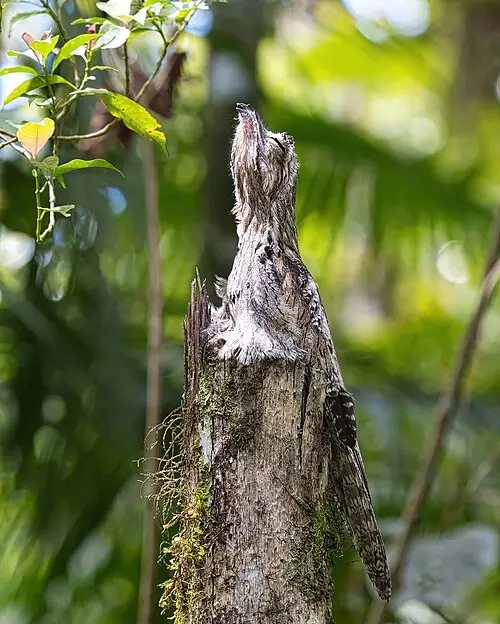
 📸 Photo
Photo: Luizalves1990 · CC BY-SA 4.0 · Wikimedia Commons Source
Common Potoo
Nyctibius griseus (Common Potoo · ハイイロタチヨタカ)
💡 Everyday Comparisons for Size, Mass & Speed
- 💡 Its maximum body length of 38 cm is slightly shorter than the long side of an A3 sheet of paper (42 cm) (Comparison).
- 💡 At night, it can be found by the eyeshine reflected when a flashlight is shone into the treetops, and its presence can also be recognized by its mournful, descending whistle-like call (Birds of the World).
Reference standards: coach bus ~12 m, mid-size car ~4.9 m, compact car ~1 t, basketball hoop 3.05 m, credit card 8.56 cm.
📖 1. Overview
The Common Potoo is a nocturnal bird that looks like a cross between an owl and a nightjar, living in lowland forest edges and open woodlands from southern Central America to northern and central South America.
🦴 2. Anatomy & Morphology
It has a large head, huge yellow eyes, and mottled gray-brown plumage. Its mouth is wide, and during the day it perches upright and motionless like a broken tree stump, making it hard to spot.
🔍 3. Ecology & Behavior
At night, it perches in places such as treetops and flies out to catch large flying insects. Without building a nest, it lays a single egg on the top of a stump or in a depression on a branch, and both parents take turns incubating it.
🇰🇷 4. Connection to Korea
No direct record connecting this species to Korea has been found.
📚 Sources & References
- • IUCN Red List LC (2020) — https://www.iucnredlist.org/species/22689646/163600335
- • IUCN Red List category LC — latest assessment at iucnredlist.org
- • doi.org — avilist.v2026
- • iucnredlist.org — 163600335
- • wikidata.org — Q1258935
- • commons.wikimedia.org — File:Parque Nacional Guaricana - Luiz Alves (01).jpg
- • sta.uwi.edu — Nyctibius griseus - Common Potoo.pdf
- • birdsoftheworld.org — introduction
- • ebird.org — compot1
Recorded dimensions are widely cited representative estimates from public literature and may vary by study or specimen.