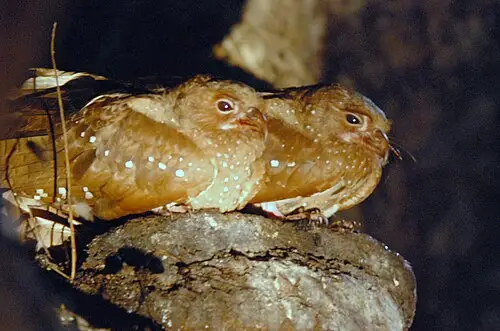
 📸 Photo
Photo: The Lilac Breasted Roller · CC BY 2.0 · Wikimedia Commons Source
Oilbird
Steatornis caripensis (Oilbird · アブラヨタカ)
💡 Everyday Comparisons for Size, Mass & Speed
- 💡 Before receiving legal protection, chicks were harvested to render oil for lamps and were also eaten as a nutritious food (ADW).
- 💡 Cueva del Guácharo National Park in Venezuela holds the largest colony of this bird and attracts birdwatchers (ADW).
Reference standards: coach bus ~12 m, mid-size car ~4.9 m, compact car ~1 t, basketball hoop 3.05 m, credit card 8.56 cm.
Site-computed relative index from recorded values; not a formal scientific metric.
📖 1. Overview
The Oilbird is a large nocturnal bird that roosts by day in mountain caves in flocks of thousands. It is a rare night-active bird that feeds exclusively on fruit.
🦴 2. Anatomy & Morphology
It has long rictal bristles around its large, hooked bill, and its large eyes have acute night vision. Its well-developed sense of smell is also thought to help it locate fruit.
🔍 3. Ecology & Behavior
At night it flies up to 25 km a day to swallow fruits of the laurel and palm families whole, then regurgitates the seeds by day, dispersing them over long distances. Chicks are fed the same fruits as adults.
🇰🇷 4. Connection to Korea
No direct record connecting this species to Korea has been found.
📚 Sources & References
- • IUCN Red List LC (2021) — https://www.iucnredlist.org/species/22689633/137757943
- • IUCN Red List category LC — latest assessment at iucnredlist.org
- • doi.org — avilist.v2026
- • iucnredlist.org — 137757943
- • wikidata.org — Q213785
- • commons.wikimedia.org — File:Oilbirds.jpg
- • animaldiversity.org — Steatornis caripensis
- • Silhouette: PhyloPic — Matías Muñoz · CC0 1.0
Recorded dimensions are widely cited representative estimates from public literature and may vary by study or specimen.