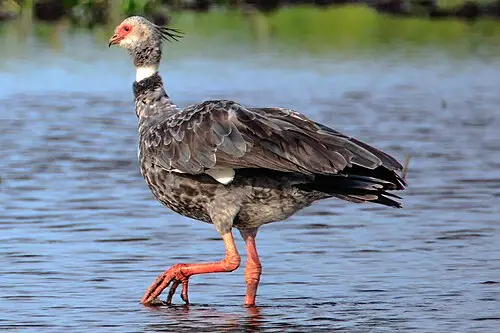
 📸 Photo
Photo: Murray Foubister · CC BY-SA 2.0 · Wikimedia Commons Source
Southern Screamer
Chauna torquata (Southern Screamer · カンムリサケビドリ)
💡 Everyday Comparisons for Size, Mass & Speed
- 💡 Because of its loud call, local people use it as a guard bird to watch over livestock (ADW).
- 💡 Its body mass of 4.4 kg is slightly lighter than a 5 kg household bag of rice (Comparison).
Reference standards: coach bus ~12 m, mid-size car ~4.9 m, compact car ~1 t, basketball hoop 3.05 m, credit card 8.56 cm.
Site-computed relative index from recorded values; not a formal scientific metric.
📖 1. Overview
The southern screamer is a large grey bird living in South American wetlands whose loud two-note call can be heard from 3 km away.
🦴 2. Anatomy & Morphology
It has small air sacs under its skin, one of the most air-filled skeletons of any bird, two sharp spurs on the front of its wings, and a white and black ring around its neck.
🔍 3. Ecology & Behavior
An herbivorous bird that grazes on grasses and aquatic plants, male and female together build a large stick nest on the ground, lay 2–7 eggs, and incubate them for 43–46 days. Outside the breeding season, flocks of up to 100 birds graze together.
🇰🇷 4. Connection to Korea
No direct record connecting this species to Korea has been found.
📚 Sources & References
- • IUCN Red List LC (2024) — https://www.iucnredlist.org/species/22679729/264995009
- • IUCN Red List category LC — latest assessment at iucnredlist.org
- • doi.org — avilist.v2026
- • iucnredlist.org — 264995009
- • wikidata.org — Q602961
- • commons.wikimedia.org — File:At Possa da Londra in the Brazilian Patanal (105m) - th
- • birdsoftheworld.org — appearance
- • animaldiversity.org — Chauna torquata
- • Silhouette: PhyloPic — Edouard Traviés · Public Domain Mark 1.0 (Congeneric silhouette — Chauna chavaria)
Recorded dimensions are widely cited representative estimates from public literature and may vary by study or specimen.