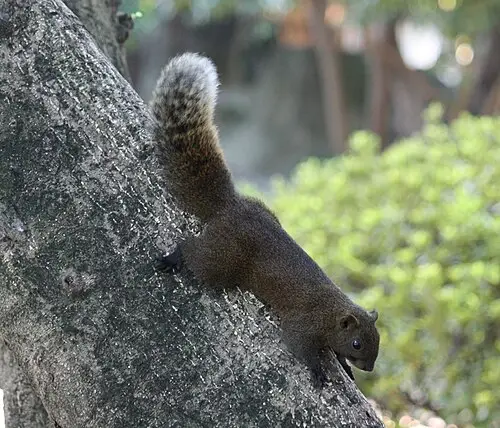
 📸 Photo
Photo: J. Patrick Fischer · CC BY-SA 3.0 · Wikimedia Commons Source
Pallas's Squirrel
Callosciurus erythraeus (Pallas's Squirrel · パラスリス)
💡 Everyday Comparisons for Size, Mass & Speed
- 💡 Its average weight of 272 g equals about four or five chicken eggs (about 60 g each), and its head-and-body length of 20 cm is similar to the short side of an A4 sheet of paper (21 cm) (Comparison).
- 💡 It plays a valuable role in the ecosystem as a seed disperser (Animal Diversity Web).
Reference standards: coach bus ~12 m, mid-size car ~4.9 m, compact car ~1 t, basketball hoop 3.05 m, credit card 8.56 cm.
Site-computed relative index from recorded values; not a formal scientific metric.
📖 1. Overview
Pallas's squirrel is a medium-sized squirrel that moves nimbly through the trees during the day in warm evergreen forests.
🦴 2. Anatomy & Morphology
Its strong claws sink into tree bark for a firm grip, and its ankles can rotate widely. Its large, protruding eyes give it sharp vision and allow it to distinguish vertical objects particularly well.
🔍 3. Ecology & Behavior
It feeds on leaves, fruits, seeds, insects, nuts, and acorns, switching its diet with the seasons. It eats camellia flowers heavily in winter and leaves in April–May.
🇰🇷 4. Connection to Korea
No direct record connecting this species to Korea has been found.
📚 Sources & References
- • IUCN Red List LC (2017) — https://www.iucnredlist.org/species/3595/22254356
- • IUCN Red List category LC — latest assessment at iucnredlist.org
- • mammaldiversity.org — 1001538
- • iucnredlist.org — 22254356
- • wikidata.org — Q860603
- • commons.wikimedia.org — File:A Sciuridae in Taipei 2.jpg
- • animaldiversity.org — Callosciurus erythraeus
- • Silhouette: PhyloPic — Kai Caspar · CC0 1.0 (Congeneric silhouette — Callosciurus prevostii)
Recorded dimensions are widely cited representative estimates from public literature and may vary by study or specimen.