 📸 Photo
Photo: Caudatejake · CC BY-SA 4.0 · Wikimedia Commons Source
Five-toed Worm Lizard
Bipes biporus (Five-toed Worm Lizard · アホロテトカゲ)
💡 Everyday Comparisons for Size, Mass & Speed
- 💡 Its maximum length of 24 cm is shorter than a 30 cm ruler and longer than a new pencil (about 17.5 cm) (Comparison).
- 💡 Because it eats large numbers of insects and small invertebrates, it is thought to help regulate their populations (University of Michigan Museum of Zoology ADW).
Reference standards: coach bus ~12 m, mid-size car ~4.9 m, compact car ~1 t, basketball hoop 3.05 m, credit card 8.56 cm.
📖 1. Overview
The Five-toed Worm Lizard is a burrowing worm lizard that is unusual in having forelimbs.
🦴 2. Anatomy & Morphology
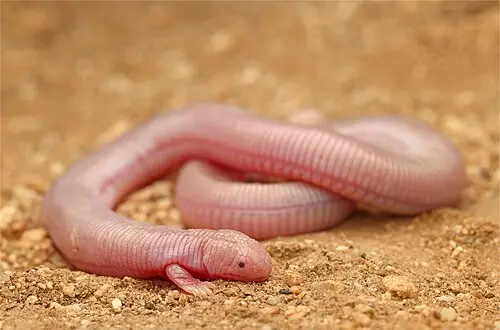
It has a small, hard head and a cylindrical body covered in ring-like scales. Its short, powerful forelimbs used for digging bear five clawed toes each, and juveniles are pink before turning white as they mature.
🔍 3. Ecology & Behavior
It catches small invertebrates such as ants and their eggs and pupae, cockroaches, termites, and beetle larvae, retreating underground to eat them. By moving between different soil depths to regulate its body temperature, it remains active year-round.
🇰🇷 4. Connection to Korea
No direct record connecting this species to Korea has been found.
📚 Sources & References
- • IUCN Red List LC (2007) — https://www.iucnredlist.org/species/63723/12710548
- • IUCN Red List category LC — latest assessment at iucnredlist.org
- • catalogueoflife.org — LVMZ
- • iucnredlist.org — 12710548
- • wikidata.org — Q763055
- • commons.wikimedia.org — File:Bipes biporus1.jpg
- • animaldiversity.org — Bipes biporus
- • Silhouette: PhyloPic — author not recorded · CC0 1.0
Recorded dimensions are widely cited representative estimates from public literature and may vary by study or specimen.