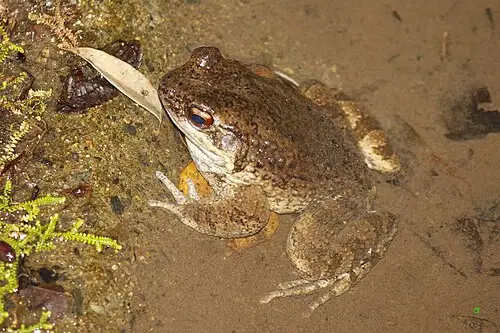
 📸 Photo
Photo: Nippon510 · CC BY-SA 4.0 · Wikimedia Commons Source
Otton Frog
Babina subaspera (Otton Frog · オットンガエル)
💡 Everyday Comparisons for Size, Mass & Speed
- 💡 Its maximum length of about 14 cm is slightly longer than five Korean 500-won coins (26.5 mm diameter) lined up in a row (132.5 mm) (Comparison).
- 💡 In Japan, it is designated as a Natural Monument of Kagoshima Prefecture and a Nationally Rare Species of Wild Fauna and Flora, making capture or trade prohibited in principle (Ministry of the Environment 5th Red Data Book; Okinawa-Amami Nature Conservation Office).
Reference standards: coach bus ~12 m, mid-size car ~4.9 m, compact car ~1 t, basketball hoop 3.05 m, credit card 8.56 cm.
📖 1. Overview
The Otton Frog is a large frog endemic to the Amami Islands of Japan. 'Otton' means 'big' in the Amami dialect, and true to its name, it is the largest frog in Amami. The IUCN assesses it as Endangered (EN, 2021).
🦴 2. Anatomy & Morphology
Snout-vent length is 93–138.5 mm in males and 111–140 mm in females, with a robust body and broad head. The back is greenish dark brown with many wart-like tubercles, and a sac-like 'false thumb' encasing a bone spine on the inner side of the first finger makes the forelimb appear to have five digits.
🔍 3. Ecology & Behavior
From April to October, it digs shallow pits 20–30 cm in diameter and about 2 cm deep in moist ground, laying 800–1,300 eggs measuring 2.0–2.5 mm in diameter. It preys on freshwater crabs, camel crickets, house centipedes, earthworms, and slugs.
🇰🇷 4. Connection to Korea
No direct record connecting this species to Korea has been found.
📚 Sources & References
- • IUCN Red List EN (2021) — https://www.iucnredlist.org/species/19172/178861822
- • IUCN Red List category EN — latest assessment at iucnredlist.org
- • catalogueoflife.org — 5VZ2L
- • iucnredlist.org — 178861822
- • wikidata.org — Q2212727
- • commons.wikimedia.org — File:オットンガエル.jpg
- • env.go.jp — AM0056 RDB5th.pdf
- • pref.kagoshima.jp — 105550 20231207093318-1.pdf
- • kyushu.env.go.jp — c-4-j.pdf
- • bok.or.kr — contents.do
- • Silhouette: PhyloPic — Beth Reinke · CC0 1.0 (Related taxon silhouette — Rana sierrae)
Recorded dimensions are widely cited representative estimates from public literature and may vary by study or specimen.