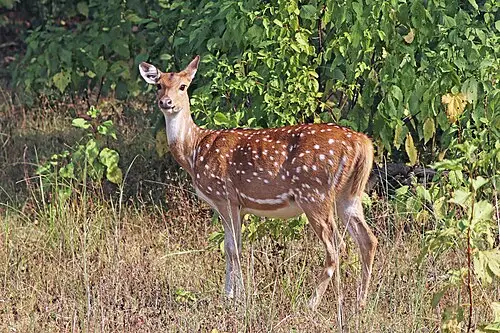
 📸 Photo
Photo: Charles J. Sharp · CC BY-SA 4.0 · Wikimedia Commons Source
Chital
Axis axis (Chital · アクシスジカ)
💡 Everyday Comparisons for Size, Mass & Speed
- 💡 In the United States, it has become an important game animal for hunting (Animal Diversity Web).
- 💡 Its maximum weight of 45 kg is about two and a half 20 kg bags of rice (Comparison).
- 💡 Its body length of 1.5 m is one-third (1/3) the length of a passenger car (about 4.5 m) (Comparison).
Reference standards: coach bus ~12 m, mid-size car ~4.9 m, compact car ~1 t, basketball hoop 3.05 m, credit card 8.56 cm.
Site-computed relative index from recorded values; not a formal scientific metric.
📖 1. Overview
The chital is a deer living in the grasslands of India and Nepal, characterized by white spots that remain throughout its life. It favors open grasslands to avoid predators such as tigers.
🦴 2. Anatomy & Morphology
Its body is reddish brown with a white belly, inner legs, and underside of the tail, while both sexes have rows of white spots and a dark stripe down the center of the back. Males grow three-tined antlers reaching nearly 1 m in length.
🔍 3. Ecology & Behavior
It feeds on grasses as well as flowers and fruits fallen from trees, and occasionally eats mushrooms. Females and young form herds, and females usually give birth to two fawns.
🇰🇷 4. Connection to Korea
No direct record connecting this species to Korea has been found.
📚 Sources & References
- • IUCN Red List LC (2015) — https://www.iucnredlist.org/species/41783/22158006
- • IUCN Red List category LC — latest assessment at iucnredlist.org
- • mammaldiversity.org — 1006307
- • iucnredlist.org — 22158006
- • wikidata.org — Q232054
- • commons.wikimedia.org — File:Spotted deer (Axis axis) female.jpg
- • animaldiversity.org — Axis axis
- • Silhouette: PhyloPic — An Ignorant Atheist · CC0 1.0 (Related taxon silhouette — Cervidae)
Recorded dimensions are widely cited representative estimates from public literature and may vary by study or specimen.