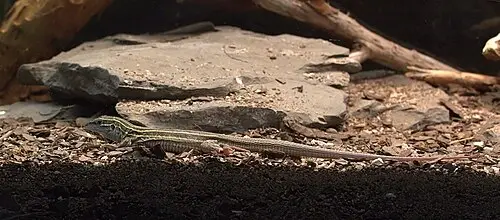
 📸 Photo
Photo: Greg Hume · CC BY-SA 3.0 · Wikimedia Commons Source
Desert Grassland Whiptail
Aspidoscelis uniparens (Desert Grassland Whiptail · Desert Grassland Whiptail)
💡 Everyday Comparisons for Size, Mass & Speed
- 💡 Its snout-to-vent length of 86 mm is almost equal to the long side of a credit card (about 85.6 mm) (Comparison).
- 💡 When grabbed, it sheds its tail and escapes while the wriggling tail distracts the predator (Toronto Zoo description).
Reference standards: coach bus ~12 m, mid-size car ~4.9 m, compact car ~1 t, basketball hoop 3.05 m, credit card 8.56 cm.
📖 1. Overview
The Desert Grassland Whiptail is a slender lizard living in grasslands of the southwestern United States and northern Mexico; the species consists solely of females and reproduces without males.
🦴 2. Anatomy & Morphology
Its small, slender body has 6–7 pale cream longitudinal stripes. Juveniles have a bright blue tail that turns turquoise or dark green as they mature.
🔍 3. Ecology & Behavior
It feeds opportunistically on insects such as ants, termites, and insect larvae. As an all-female parthenogenetic species, its offspring are clones of their mother; it lays clutches of 1–4 eggs in late spring to early summer, which hatch after about two months.
🇰🇷 4. Connection to Korea
No direct record connecting this species to Korea has been found.
📚 Sources & References
- • IUCN Red List LC (2007) — https://www.iucnredlist.org/species/64291/12754846
- • IUCN Red List category LC — latest assessment at iucnredlist.org
- • catalogueoflife.org — HHJQ
- • iucnredlist.org — 12754846
- • wikidata.org — Q2382425
- • commons.wikimedia.org — File:DesertGrasslandWhiptail.jpg
- • torontozoo.com — Desert grassland whiptail
- • reptile-database.reptarium.cz — species
- • Silhouette: PhyloPic — Gopal Murali · CC0 1.0 (Congeneric silhouette — Aspidoscelis sonorae)
Recorded dimensions are widely cited representative estimates from public literature and may vary by study or specimen.