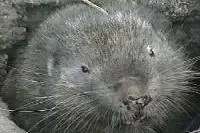
 📸 Photo
Photo: Western Ecological Research Center · Public domain · Wikimedia Commons Source
Mountain Beaver
Aplodontia rufa (Mountain Beaver · ヤマビーバー)
💡 Everyday Comparisons for Size, Mass & Speed
- 💡 Its average weight of 0.8 kg is slightly lighter than a 1 kg bag of sugar, and its body length of 50 cm is half of a 1 m tape measure (Comparison).
- 💡 Although called a "beaver," it is not an aquatic animal like true beavers. Animal Diversity Web notes that it has no known positive economic importance for humans.
Reference standards: coach bus ~12 m, mid-size car ~4.9 m, compact car ~1 t, basketball hoop 3.05 m, credit card 8.56 cm.
Site-computed relative index from recorded values; not a formal scientific metric.
📖 1. Overview
Despite its name, the mountain beaver is a rodent that lives neither in high mountains nor in water, dwelling instead in underground burrows in moist forests.
🦴 2. Anatomy & Morphology
It has a small, stocky, cylindrical body with almost no tail, and coarse, dense blackish fur. All five toes on each foot are roughly equal in length, and there is a small white spot at the base of each ear.
🔍 3. Ecology & Behavior
Ferns make up most of its diet, along with conifers, grasses, mosses, and shrubs, including plants that are toxic to other animals. Mostly solitary, it spends most of its time underground in burrows that can have up to 30 exits.
🇰🇷 4. Connection to Korea
No direct record connecting this species to Korea has been found.
📚 Sources & References
- • IUCN Red List LC (2016) — https://www.iucnredlist.org/species/1869/115057269
- • IUCN Red List category LC — latest assessment at iucnredlist.org
- • mammaldiversity.org — 1001504
- • iucnredlist.org — 115057269
- • wikidata.org — Q503813
- • commons.wikimedia.org — File:Aplodontia.jpg
- • animaldiversity.org — Aplodontia rufa
Recorded dimensions are widely cited representative estimates from public literature and may vary by study or specimen.