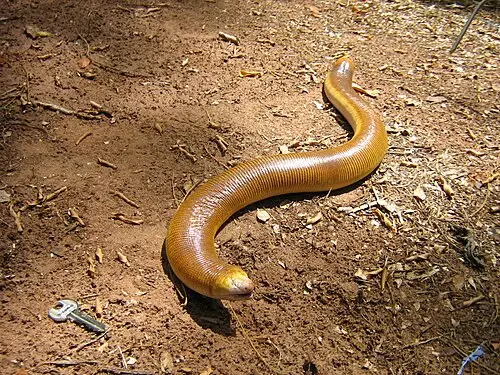
 📸 Photo
Photo: Diogo B. Provete · CC BY-SA 2.5 · Wikimedia Commons Source
Red Worm Lizard
Amphisbaena alba (Red Worm Lizard · Red Worm Lizard)
💡 Everyday Comparisons for Size, Mass & Speed
- 💡 Its length of 80 cm is about the length of a long umbrella, and its thickness of 3 cm is slightly wider than the diameter of a Korean 500-won coin (about 2.65 cm) (Comparison).
- 💡 Because it feeds on ants and termites, it is said to help reduce pests (University of the West Indies material).
Reference standards: coach bus ~12 m, mid-size car ~4.9 m, compact car ~1 t, basketball hoop 3.05 m, credit card 8.56 cm.
📖 1. Overview
The Red Worm Lizard is a large, worm-like legless reptile that lives underground in South America and on the island of Trinidad.
🦴 2. Anatomy & Morphology
It lacks legs, has scales arranged in rings around its body, and has a short tail that makes it look two-headed. Its eyes are tiny, its ears are covered, and its thick, sturdy jawbones give it a powerful bite.
🔍 3. Ecology & Behavior
Underground, it preys on small vertebrates such as mice as well as leafcutter ants, beetles, crickets, and termites. It lays 8–16 eggs in ant or termite nests, and when threatened it raises both its head and tail to confuse predators.
🇰🇷 4. Connection to Korea
No direct record connecting this species to Korea has been found.
📚 Sources & References
- • IUCN Red List LC (2019) — https://www.iucnredlist.org/species/176224/1436233
- • IUCN Red List category LC — latest assessment at iucnredlist.org
- • catalogueoflife.org — D5FY
- • iucnredlist.org — 1436233
- • wikidata.org — Q1290784
- • commons.wikimedia.org — File:Amphisbaena alba03.jpg
- • sta.uwi.edu — Amphisbaena alba - White Worm Lizard.pdf
- • Silhouette: PhyloPic — Roberto Díaz Sibaja · CC BY 3.0 (Congeneric silhouette — Amphisbaena microcephala)
Recorded dimensions are widely cited representative estimates from public literature and may vary by study or specimen.