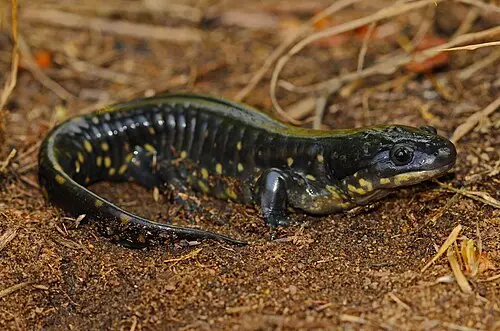
 📸 Photo
Photo: Peter Paplanus · CC BY 2.0 · Wikimedia Commons Source
Eastern Tiger Salamander
Ambystoma tigrinum (Eastern Tiger Salamander · タイガーサラマンダー)
💡 Everyday Comparisons for Size, Mass & Speed
- 💡 A maximum body length of 33 cm is 3–4 cm longer than the long side of an A4 sheet of paper (29.7 cm) (Comparison).
- 💡 A maximum body length of 33 cm is about half the length of an adult human arm (about 60–70 cm) (Comparison).
Reference standards: coach bus ~12 m, mid-size car ~4.9 m, compact car ~1 t, basketball hoop 3.05 m, credit card 8.56 cm.
📖 1. Overview
The Eastern Tiger Salamander is the most widespread salamander in North America, ranging from southeastern Alaska to the southern Mexican Plateau, and is introduced as the largest terrestrial salamander in North America. It is listed as Least Concern (LC, 2022) on the IUCN Red List.
🦴 2. Anatomy & Morphology
It has a stout body with a rounded snout and round eyes, often with yellow blotches on a black background. Males are generally longer and have flatter tails.
🔍 3. Ecology & Behavior
Adults eat earthworms, snails, insects, and slugs, and migrate to breeding ponds after warm rains in late winter to early spring to lay eggs. They lay about 100–1,000 eggs at a time, which hatch in 19–50 days, and larvae metamorphose in 2.5–5 months.
🇰🇷 4. Connection to Korea
No direct record connecting this species to Korea has been found.
📚 Sources & References
- • IUCN Red List LC (2022) — https://www.iucnredlist.org/species/83293207/196342827
- • IUCN Red List category LC — latest assessment at iucnredlist.org
- • catalogueoflife.org — CQ5H
- • iucnredlist.org — 196342827
- • wikidata.org — Q113224
- • commons.wikimedia.org — File:Tigersalamander (Ambystoma tigrinum), Seitenansicht 1.j
- • animaldiversity.org — Ambystoma tigrinum
- • Silhouette: PhyloPic — Zachary Quigley · CC BY 3.0
Recorded dimensions are widely cited representative estimates from public literature and may vary by study or specimen.