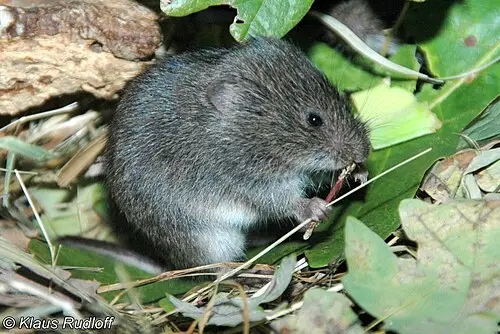
 📸 Photo
Photo: Klaus Rudloff · CC BY-SA 4.0 · Wikimedia Commons Source
Reed Vole
Alexandromys fortis (Reed Vole · Reed Vole)
💡 Everyday Comparisons for Size, Mass & Speed
- 💡 Its fur length of 15 mm is just over half the diameter of a Korean 500-won coin (about 26.5 mm) (Comparison).
- 💡 It lives in wetlands thick with silver grass and reeds, and its burrows usually have 6 holes arranged on a single flat plane (National List of Species of Korea).
Reference standards: coach bus ~12 m, mid-size car ~4.9 m, compact car ~1 t, basketball hoop 3.05 m, credit card 8.56 cm.
📖 1. Overview
The reed vole is a vole living in wetlands thick with silver grass, reeds, and wild rice, avoiding dry ground.
🦴 2. Anatomy & Morphology
Its fur is soft and fine, measuring about 15 mm, with long guard hairs over 20 mm. Its back is sepia brown and its underside is grayish white.
🔍 3. Ecology & Behavior
It feeds mainly on young shoots of silver grass and wild rice, and shreds their leaves to build its nest. Its burrows usually have 6 entrances arranged on a single plane, and it gives birth once a year in July–August to a litter of 2–4 young.
🇰🇷 4. Connection to Korea
It is listed under the Korean name Galbatjwi in the National List of Species of Korea and has been collected in Manpo, Najin, Geumhwa, Cheongwon, and Yangpyeong.
📚 Sources & References
- • IUCN Red List LC (2016) — https://www.iucnredlist.org/species/13430/115112605
- • IUCN Red List category LC — latest assessment at iucnredlist.org
- • mammaldiversity.org — 1002026
- • iucnredlist.org — 115112605
- • 국가생물종목록(국립생물자원관) ktsn 120000053449 — https://species.nibr.go.kr/home/mainHome.do?cont_link=009&subMenu=009002&contCd=009002&ktsn=120000053449
- • wikidata.org — Q125912766
- • commons.wikimedia.org — File:Microtus fortis Plzen.jpg
- • species.nibr.go.kr — mainHome.do
- • Silhouette: PhyloPic — Titouan Montessuit · CC BY 4.0 (Congeneric silhouette — Microtus arvalis)
Recorded dimensions are widely cited representative estimates from public literature and may vary by study or specimen.