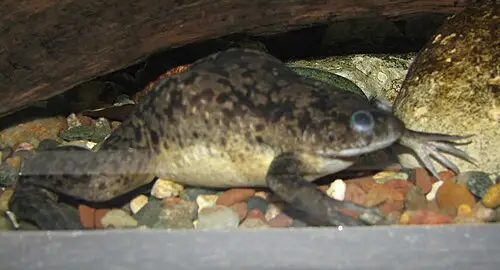
 📸 Photo
Photo: No machine-readable author provided. Ltshears assumed (based on copyright claims). · Public domain · Wikimedia Commons Source
African Clawed Frog
Xenopus laevis (African Clawed Frog · アフリカツメガエル)
💡 Everyday Comparisons for Size, Mass & Speed
- 💡 A female's weight of 200 g is about that of an apple, and a body length of 12 cm is about 1.4 times the long side of a credit card (85.6 mm) (Comparison).
- 💡 Because females lay many eggs and have transparent embryos, it has been widely used as a laboratory animal in vertebrate development research, and in the 1940s it was also used for pregnancy testing because females lay eggs when injected with a pregnant woman's urine (ADW, 'Positive Impacts').
- 💡 It has spread as an introduced species to several countries, turning up in freshwaters of the United States, Chile, France, Indonesia, Portugal, the United Kingdom, and Italy (Smithsonian's National Zoo).
Reference standards: coach bus ~12 m, mid-size car ~4.9 m, compact car ~1 t, basketball hoop 3.05 m, credit card 8.56 cm.
Site-computed relative index from recorded values; not a formal scientific metric.
📖 1. Overview
The African Clawed Frog is native to eastern and southern Africa and spends almost its entire life in water. As an introduced species, it is now also found in freshwaters of the United States, Chile, France, Indonesia, Portugal, the United Kingdom, and Italy. It is assessed as Least Concern (LC, 2025 assessment) on the IUCN Red List.
🦴 2. Anatomy & Morphology
Lacking a tongue, visible ears, and eyelids, it has a flattened body and a wedge-shaped head. Its forelimbs are small and unwebbed, while its hind legs are large and webbed with claws on the three inner toes, and it has a lateral line system that senses vibrations in water.
🔍 3. Ecology & Behavior
A scavenger that eats dead or dying arthropods and organic waste, it locates food using its sensitive fingers, keen sense of smell, and lateral line, and tears apart large prey with its hind claws. When ponds dry up, it can estivate in mud for nearly 1 year, reaches adulthood in 10–12 months, and lives up to about 15 years.
🇰🇷 4. Connection to Korea
No direct record connecting this species to Korea has been found.
📚 Sources & References
- • IUCN Red List LC (2025) — https://www.iucnredlist.org/species/110466172/248905894
- • IUCN Red List category LC — latest assessment at iucnredlist.org
- • catalogueoflife.org — 5CBC9
- • iucnredlist.org — 248905894
- • wikidata.org — Q654718
- • commons.wikimedia.org — File:African Clawed Frog.jpg
- • animaldiversity.org — Xenopus laevis
- • nationalzoo.si.edu — african-clawed-frog
- • Silhouette: PhyloPic — Sarah Werning · CC BY 3.0
Recorded dimensions are widely cited representative estimates from public literature and may vary by study or specimen.