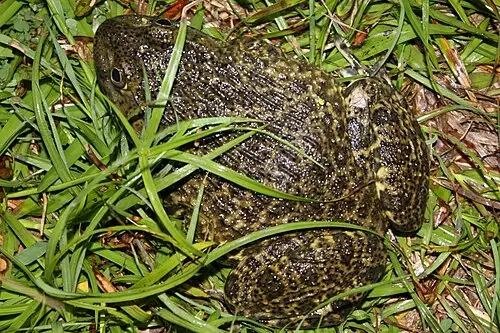
 📸 Photo
Photo: Thomas Brown · CC BY 2.0 · Wikimedia Commons Source
Chinese Edible Frog
Hoplobatrachus rugulosus (Chinese Edible Frog · Chinese Edible Frog)
💡 Everyday Comparisons for Size, Mass & Speed
- 💡 Its body length of 15 cm is about 1.75 times the long side of a credit card (85.6 mm) (Comparison).
- 💡 Called 'water chicken' (Shuiji) for its tasty meat, heavy harvesting once reduced its numbers so that it was designated a protected species in Taiwan before being returned to general status in 2008 (Taiwan Encyclopedia of Life).
- 💡 In Hong Kong, the University of Hong Kong database notes that populations are declining due to habitat loss and hunting for food.
Reference standards: coach bus ~12 m, mid-size car ~4.9 m, compact car ~1 t, basketball hoop 3.05 m, credit card 8.56 cm.
📖 1. Overview
The Chinese Edible Frog is a large frog living in rice paddies, ponds, and slow streams, widely distributed from south-central China to Thailand. It is assessed as Least Concern (LC, 2022) on the IUCN Red List.
🦴 2. Anatomy & Morphology
Its body length is usually 6–12 cm and up to 15 cm, with an olive to gray-brown back covered in black spots, elongated folds, and very rough skin. It has a large, pointed mouth, large eardrums, and fully webbed toes.
🔍 3. Ecology & Behavior
Very shy, it immediately leaps away when it sees a person, yet it has a voracious appetite and preys on other frogs, small rodents, and insects. It breeds in spring and summer, laying floating clumps of eggs on the water, and its huge tadpoles grow up to 5 cm long.
🇰🇷 4. Connection to Korea
No direct record connecting this species to Korea has been found.
📚 Sources & References
- • IUCN Red List LC (2022) — https://www.iucnredlist.org/species/58300/53725185
- • IUCN Red List category LC — latest assessment at iucnredlist.org
- • catalogueoflife.org — 6MC5T
- • iucnredlist.org — 53725185
- • wikidata.org — Q711322
- • commons.wikimedia.org — File:Chinese Bullfrog (Hoplobatrachus rugulosus) 虎紋蛙(田雞)9.jp
- • taieol.tw — 238165
- • biosch.hku.hk — Hoplobatrachus chinensis.htm
- • Silhouette: PhyloPic — Jose Carlos Arenas-Monroy · CC0 1.0 (Related taxon silhouette — Fejervarya limnocharis)
Recorded dimensions are widely cited representative estimates from public literature and may vary by study or specimen.