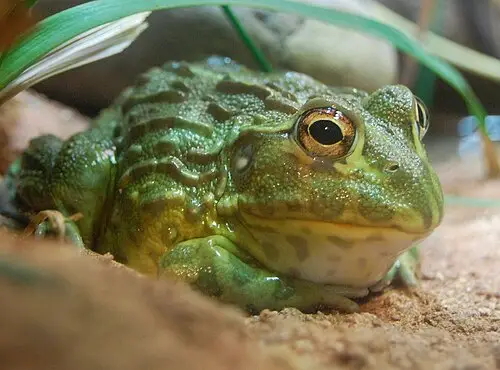
 📸 Photo
Photo: Steven G. Johnson · CC BY-SA 3.0 · Wikimedia Commons Source
African Bullfrog
Pyxicephalus adspersus (African Bullfrog · アフリカウシガエル)
💡 Everyday Comparisons for Size, Mass & Speed
- 💡 The male body length of 23 cm is slightly longer than the short side of an A4 sheet of paper (21 cm), and 0.9 kg is slightly lighter than a 1 L carton of milk (about 1 kg) (Comparison).
- 💡 Local people catch it for food, and it is also sold in the pet trade (ADW, 'Positive Impacts').
Reference standards: coach bus ~12 m, mid-size car ~4.9 m, compact car ~1 t, basketball hoop 3.05 m, credit card 8.56 cm.
Site-computed relative index from recorded values; not a formal scientific metric.
📖 1. Overview
The African Bullfrog is a large frog from dry parts of Africa that spends most of its life underground and emerges only in the rainy season to breed. It is assessed as Least Concern (LC, 2013 assessment) on the IUCN Red List.
🦴 2. Anatomy & Morphology
Males grow to more than 9 inches (about 23 cm) and weigh over 2 pounds (about 0.9 kg), while females are much smaller. Its olive body has longitudinal ridges on the back, males have a yellow to orange throat, and each hind foot bears a spade-like tubercle for digging.
🔍 3. Ecology & Behavior
It eats anything it can swallow—including insects, frogs, reptiles, small mammals, and small birds—and cannibalizing siblings from the same egg mass right after metamorphosis is common. During the dry season it rests underground for more than 1 year inside a cocoon made of shed skin, emerging to temporary pools when the rains arrive.
🇰🇷 4. Connection to Korea
No direct record connecting this species to Korea has been found.
📚 Sources & References
- • IUCN Red List LC (2013) — https://www.iucnredlist.org/species/58535/3070700
- • IUCN Red List category LC — latest assessment at iucnredlist.org
- • catalogueoflife.org — 4QYCF
- • iucnredlist.org — 3070700
- • wikidata.org — Q387319
- • commons.wikimedia.org — File:Pyxicephalus adspersus, Boston Aquarium.jpg
- • animaldiversity.org — Pyxicephalus adspersus
- • Silhouette: PhyloPic — Jose Carlos Arenas-Monroy · CC0 1.0
Recorded dimensions are widely cited representative estimates from public literature and may vary by study or specimen.