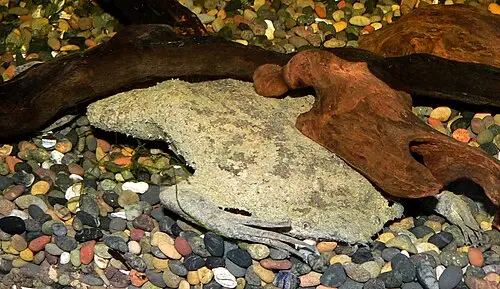
 📸 Photo
Photo: User:Stan Shebs · CC BY-SA 3.0 · Wikimedia Commons Source
Surinam Toad
Pipa pipa (Surinam Toad · ピパピパ)
💡 Everyday Comparisons for Size, Mass & Speed
- 💡 The female body length of 17 cm is similar to a new pencil (about 17.5 cm) (Comparison).
- 💡 Eggs developing embedded like a honeycomb in the mother's back represent a unique mode of reproduction, and ADW notes that apart from occasionally eating insect pests it provides no economic benefit to humans.
Reference standards: coach bus ~12 m, mid-size car ~4.9 m, compact car ~1 t, basketball hoop 3.05 m, credit card 8.56 cm.
📖 1. Overview
The Surinam Toad is an aquatic frog living in murky ponds and swamps, famous for its unusual breeding method of raising eggs embedded in the mother's back. It is assessed as Least Concern (LC, 2023 assessment) on the IUCN Red List.
🦴 2. Anatomy & Morphology
Its body is broad and extremely flat with a triangular head, and its eyes are tiny black bead-like organs without eyelids. Its hind feet are large and flipper-like, while its forelegs are short with fingertips split into four star-like sensory lobes.
🔍 3. Ecology & Behavior
Lacking a tongue, this omnivore uses its long, sensitive front fingers to feel along pond bottoms for worms, crustaceans, and small fish. Females brood eggs inside honeycomb-like pockets on their backs and release miniature frogs without a tadpole stage, while males call mates underwater with rapid clicking sounds.
🇰🇷 4. Connection to Korea
No direct record connecting this species to Korea has been found.
📚 Sources & References
- • IUCN Red List LC (2023) — https://www.iucnredlist.org/species/58163/85900348
- • IUCN Red List category LC — latest assessment at iucnredlist.org
- • catalogueoflife.org — 4J2ZG
- • iucnredlist.org — 85900348
- • wikidata.org — Q220414
- • commons.wikimedia.org — File:Pipa pipa 1.jpg
- • animaldiversity.org — Pipa pipa
- • Silhouette: PhyloPic — author not recorded · CC0 1.0
Recorded dimensions are widely cited representative estimates from public literature and may vary by study or specimen.