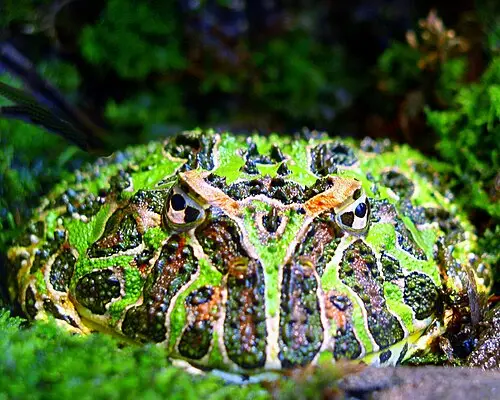
 📸 Photo
Photo: Flickr.com user "avmaier" · CC BY 2.0 · Wikimedia Commons Source
Argentine Horned Frog
Ceratophrys ornata (Argentine Horned Frog · ベルツノガエル)
💡 Everyday Comparisons for Size, Mass & Speed
- 💡 Because experiments show that the insecticide ingredient chlorpyrifos used near farmland disrupts the hunting behavior of its tadpoles, this frog serves as a study subject illustrating how pesticides affect amphibians.
- 💡 Climate modeling studies estimate its current suitable habitat area at about 25,563 km², roughly one-quarter (1/4) the area of South Korea (about 100,000 km²) (Comparison).
Reference standards: coach bus ~12 m, mid-size car ~4.9 m, compact car ~1 t, basketball hoop 3.05 m, credit card 8.56 cm.
📖 1. Overview
The Argentine Horned Frog is a horned frog inhabiting the Pampas grasslands of Argentina and southern Brazil, living not only in grasslands but also in farmland and urban areas. It is listed as Vulnerable (VU, assessed in 2025) on the IUCN Red List.
🦴 2. Anatomy & Morphology
Family-wide descriptions of Ceratophryidae note that their specialized jaw and swallowing structure allows them to consume prey very large relative to their body size. Specific body length and weight figures for this species were not found in the official sources consulted.
🔍 3. Ecology & Behavior
Even the tadpoles are carnivorous, acting in experiments as predators that eat the tadpoles of other frogs (Rhinella fernandezae). Exposure to the pesticide ingredient chlorpyrifos has been reported to disrupt this predator-prey relationship.
🇰🇷 4. Connection to Korea
No direct record connecting this species to Korea has been found.
📚 Sources & References
- • IUCN Red List VU (2025) — https://www.iucnredlist.org/species/56340/298219171
- • IUCN Red List category VU — latest assessment at iucnredlist.org
- • catalogueoflife.org — SNTS
- • iucnredlist.org — 298219171
- • wikidata.org — Q954868
- • commons.wikimedia.org — File:Argentine horned frog (Ceratophrys ornata).jpg
- • arxiv.org — 2105.12050
- • pmc.ncbi.nlm.nih.gov — PMC4769514
- • pmc.ncbi.nlm.nih.gov — PMC6135375
- • Silhouette: PhyloPic — Margot Michaud · CC0 1.0
Recorded dimensions are widely cited representative estimates from public literature and may vary by study or specimen.