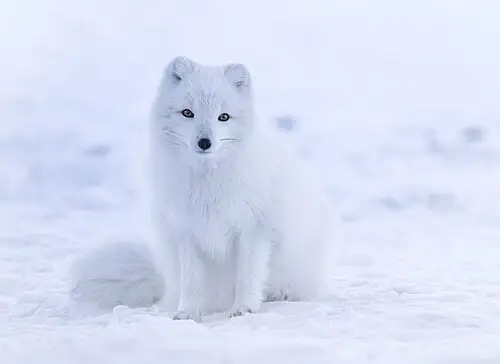
 📸 Photo
Photo: Jonatan Pie ( unsplash.com/@r3dmax ) · CC0 · Wikimedia Commons Source
Arctic Fox
Vulpes lagopus (Arctic Fox · ホッキョクギツネ)
💡 Everyday Comparisons for Size, Mass & Speed
- 💡 Its average weight of 5.2 kg is about 1/4 of a 20 kg bag of rice, and its total length of about 1.1 m including the tail is about the height of a lower-grade elementary school child (Comparison).
- 💡 Arctic Fox fur is prized in the fur industry, and on the Pribilof Islands of Alaska it has been farmed for fur since 1865 (ADW).
Reference standards: coach bus ~12 m, mid-size car ~4.9 m, compact car ~1 t, basketball hoop 3.05 m, credit card 8.56 cm.
Site-computed relative index from recorded values; not a formal scientific metric.
📖 1. Overview
The Arctic Fox is a canid living in treeless Arctic and alpine tundra, mainly along coasts. Even in winter it does not hibernate and roams in bands in search of food.
🦴 2. Anatomy & Morphology
Its coat turns white in winter, completing its white winter fur by November (month 11), and molting begins in early spring (April, month 4). In Alaska, its average length including the tail is about 109 cm, with the tail measuring about 38 cm.
🔍 3. Ecology & Behavior
An opportunistic hunter, it favors small mammals such as lemmings and also eats insects, berries, and carrion. In winter it also feeds on marine mammals, seabirds, and fish. Gestation lasts about 52 days, and females give birth to an average of 7 kits (up to 15).
🇰🇷 4. Connection to Korea
No direct record connecting this species to Korea has been found.
📚 Sources & References
- • IUCN Red List LC (2014) — https://www.iucnredlist.org/species/899/57549321
- • IUCN Red List category LC — latest assessment at iucnredlist.org
- • mammaldiversity.org — 1005972
- • iucnredlist.org — 57549321
- • wikidata.org — Q82738
- • commons.wikimedia.org — File:Vulpes lagopus in Iceland (cropped).jpg
- • adfg.alaska.gov — index.cfm
- • animaldiversity.org — Vulpes lagopus
- • Silhouette: PhyloPic — author not recorded · Public Domain Mark 1.0
Recorded dimensions are widely cited representative estimates from public literature and may vary by study or specimen.