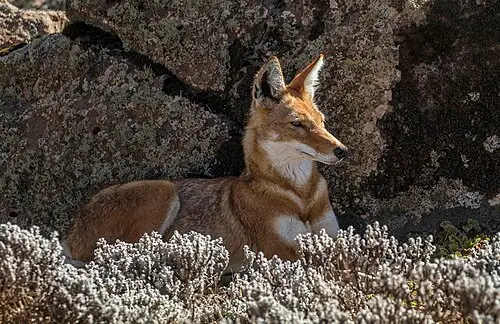
 📸 Photo
Photo: Charles J. Sharp · CC BY-SA 4.0 · Wikimedia Commons Source
Ethiopian Wolf
Canis simensis (Ethiopian Wolf · アビシニアジャッカル)
💡 Everyday Comparisons for Size, Mass & Speed
- 💡 Its maximum weight of 19.3 kg is about one 20 kg bag of rice, and its head-and-body length of about 1 m is roughly the height of a lower-grade elementary school child (Comparison).
- 💡 It helps regulate rodent numbers in its habitat (ADW). Whole packs can be seen gathering at dawn, midday, and evening to greet one another and patrol their borders.
Reference standards: coach bus ~12 m, mid-size car ~4.9 m, compact car ~1 t, basketball hoop 3.05 m, credit card 8.56 cm.
Site-computed relative index from recorded values; not a formal scientific metric.
📖 1. Overview
The Ethiopian wolf is a canid native to the alpine grasslands of Ethiopia, living in short-grass meadows and scrublands at elevations of 3,000–4,400 m.
🦴 2. Anatomy & Morphology
It has long legs and a slender build, with a red coat and white legs, belly, tail, face, and chin. The boundary between red and white is sharp, with a white crescent below the eyes, broad pointed ears, and a black nose.
🔍 3. Ecology & Behavior
It feeds mainly on rodents, especially the giant mole-rat (Tachyoryctes macrocephalus). Although it forms packs of 3–13 individuals (averaging 6), it hunts mostly alone during the day. An analysis of 689 droppings showed that murid rodents made up 95.8% of its prey.
🇰🇷 4. Connection to Korea
No direct record connecting this species to Korea has been found.
📚 Sources & References
- • IUCN Red List EN (2011) — https://www.iucnredlist.org/species/3748/10051312
- • IUCN Red List category EN — latest assessment at iucnredlist.org
- • mammaldiversity.org — 1005946
- • iucnredlist.org — 10051312
- • wikidata.org — Q188957
- • commons.wikimedia.org — File:Ethiopian wolf (Canis simensis citernii) 2.jpg
- • animaldiversity.org — Canis simensis
- • Silhouette: PhyloPic — Margot Michaud · CC0 1.0
Recorded dimensions are widely cited representative estimates from public literature and may vary by study or specimen.