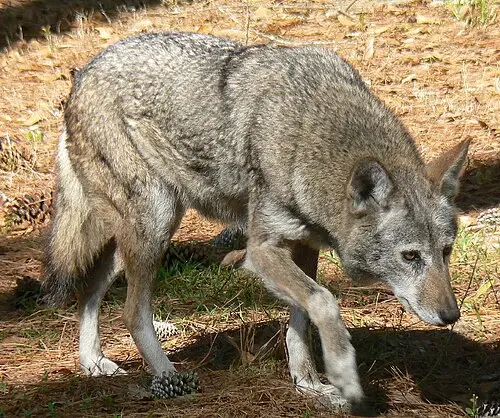
 📸 Photo
Photo: Tim Ross · Public domain · Wikimedia Commons Source
Red Wolf
Canis rufus (Red Wolf · カニス・ルフス)
💡 Everyday Comparisons for Size, Mass & Speed
- 💡 Its speed of 48 km/h is close to an urban road speed limit (50 km/h), and its maximum weight of 40 kg equals two 20 kg bags of rice (Comparison).
- 💡 By eating many rodents, it helps control pest populations (ADW). Despite the name "red," coat color varies considerably among individuals, with some having a heavy mix of gray and black (Smithsonian).
Reference standards: coach bus ~12 m, mid-size car ~4.9 m, compact car ~1 t, basketball hoop 3.05 m, credit card 8.56 cm.
Site-computed relative index from recorded values; not a formal scientific metric.
📖 1. Overview
The red wolf is a medium-sized wolf found only in the United States, surviving in the wild only in a single recovery area in northeastern North Carolina after once ranging from Texas to Pennsylvania.
🦴 2. Anatomy & Morphology
Smaller and leaner than the gray wolf, it has longer legs and ears and shorter fur. Its coat mixes cinnamon and tawny tones with gray or black, showing a reddish cast on the ears, head, and legs, and its tail is tipped with black.
🔍 3. Ecology & Behavior
It preys on rodents, ungulates, and other mammals such as raccoons, white-tailed deer, and swamp rabbits, and also eats carrion. It hunts in one area for 7–10 days before moving to another. Gestation lasts 60–63 days, with litters averaging 3–6 pups.
🇰🇷 4. Connection to Korea
No direct record connecting this species to Korea has been found.
📚 Sources & References
- • IUCN Red List category CR — latest assessment at iucnredlist.org
- • mammaldiversity.org — 1005945
- • iucnredlist.org — 3747
- • wikidata.org — Q28196316
- • commons.wikimedia.org — File:07-03-23RedWolfAlbanyGAChehaw.jpg
- • animaldiversity.org — Canis rufus
- • nationalzoo.si.edu — red-wolf
- • Silhouette: PhyloPic — Margot Michaud · CC0 1.0
Recorded dimensions are widely cited representative estimates from public literature and may vary by study or specimen.