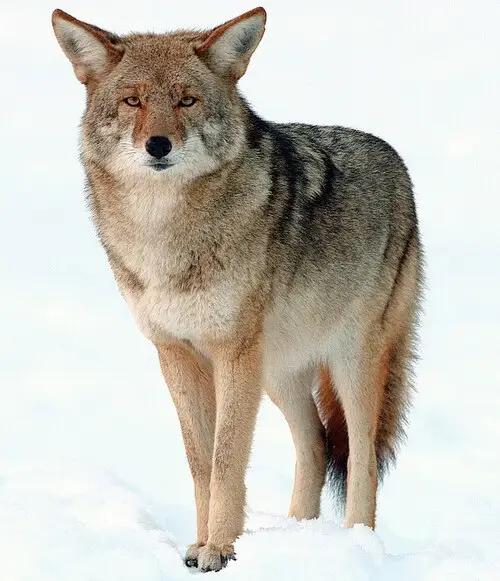
 📸 Photo
Photo: Yathin S Krishnappa · CC BY-SA 3.0 · Wikimedia Commons Source
Coyote
Canis latrans (Coyote · コヨーテ)
💡 Everyday Comparisons for Size, Mass & Speed
- 💡 Its top speed of 65 km/h is faster than an urban road speed limit (50 km/h), and its maximum weight of 21 kg is similar to one 20 kg bag of rice (Comparison).
- 💡 Seen in cities, suburbs, and farmlands, it sometimes eats trash and household pets, while also helping reduce crop pests such as rodents and providing pelts traded in some regions (ADW).
Reference standards: coach bus ~12 m, mid-size car ~4.9 m, compact car ~1 t, basketball hoop 3.05 m, credit card 8.56 cm.
Site-computed relative index from recorded values; not a formal scientific metric.
📖 1. Overview
The coyote is a highly adaptable North American canid that lives not only in forests and deserts, but also in suburbs and cities. It is usually absent from areas inhabited by gray wolves.
🦴 2. Anatomy & Morphology
Its coat ranges from grayish brown to yellowish gray with a whitish throat and belly. Long black-tipped hairs form a stripe down the back, and its bottle-shaped, black-tipped tail is about half its body length. It is much smaller than a gray wolf and much larger than a fox.
🔍 3. Ecology & Behavior
A versatile hunter whose diet is 90% mammals, it mainly catches rabbits and rodents, while also eating carrion, fruits, and human trash. Gestation lasts 60–63 days, and litters average 6 pups, with a maximum of 19.
🇰🇷 4. Connection to Korea
No direct record connecting this species to Korea has been found.
📚 Sources & References
- • IUCN Red List LC (2018) — https://www.iucnredlist.org/species/3745/163508579
- • IUCN Red List category LC — latest assessment at iucnredlist.org
- • mammaldiversity.org — 1005941
- • iucnredlist.org — 163508579
- • wikidata.org — Q44299
- • commons.wikimedia.org — File:2009-Coyote-Yosemite.jpg
- • animaldiversity.org — Canis latrans
- • Silhouette: PhyloPic — Richard Rich · CC0 1.0
Recorded dimensions are widely cited representative estimates from public literature and may vary by study or specimen.