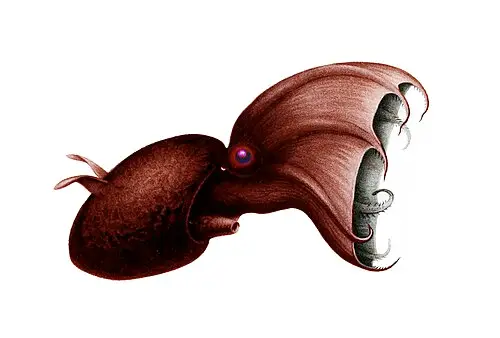
 📸 Photo
Photo: Carl Chun · Public domain · Wikimedia Commons Source
Vampire squid
Vampyroteuthis infernalis (Vampire squid · コウモリダコ)
Not Evaluated (NE) on the IUCN Red List yet.
💡 Everyday Comparisons for Size, Mass & Speed
- 💡 Its maximum total length of 30 cm is the same length as a student's 30 cm ruler (Comparison).
- 💡 Its habitat depth of 600–900 m is deeper than the height of Lotte World Tower in Seoul (555 m) (Comparison).
- 💡 Because its food, 'marine snow', consists of sunken dead plankton and feces, biological activity in surface waters becomes the dining table of the deep sea (MBARI).
Reference standards: coach bus ~12 m, mid-size car ~4.9 m, compact car ~1 t, basketball hoop 3.05 m, credit card 8.56 cm.
📖 1. Overview
Contrary to its name, the vampire squid neither sucks blood nor is a true squid, but is the last surviving species of an ancient cephalopod lineage. It lives in the oxygen-minimum layer of the deep sea.
🦴 2. Anatomy & Morphology
Webbing connects its arms, and when threatened it turns its webbed arms inside out to wrap around its body, exposing soft projections (cirri) on the inside. Its dark reddish-brown body has two long, sticky filaments.
🔍 3. Ecology & Behavior
Rather than hunting, it uses its filaments to gather and eat 'marine snow'—clumps of dead plankton, fecal matter, and mucus sinking from above. Because this method uses very little energy, it can survive even in layers with little oxygen.
🇰🇷 4. Connection to Korea
No direct record connecting this species to Korea has been found.
📚 Sources & References
- • IUCN Red List: not evaluated (NE) — cross-checked with the Wikidata conservation-status entry
- • marinespecies.org — aphia.php
- • wikidata.org — Q2509902
- • commons.wikimedia.org — File:Vampyroteuthis infernalis.jpg
- • mbari.org — vampire-squid
- • mbari.org — mbari-researchers-discover-what-vampire-squids-eat-its-not-w
- • sealifebase.se — Vampyroteuthis-infernalis.html
- • Silhouette: PhyloPic — author not recorded · Public Domain Mark 1.0
Recorded dimensions are widely cited representative estimates from public literature and may vary by study or specimen.