 📸 Photo
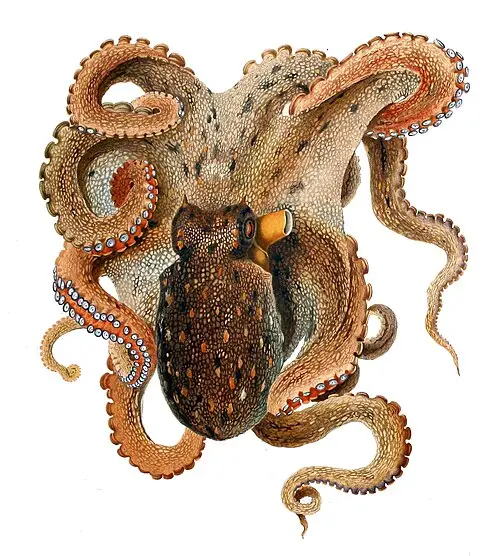
Photo: Comingio Merculiano (1845-1915) in Jatta Giuseppe (1860-1903) · Public domain · Wikimedia Commons Source
Common octopus
Octopus vulgaris (Common octopus · チチュウカイマダコ)
💡 Everyday Comparisons for Size, Mass & Speed
- 💡 The body length of about 1.3 m in Korean individuals is close to 1/3 the length of a passenger car (about 4.5 m) (Comparison).
- 💡 Its maximum published weight of 10 kg is half of a 20 kg bag of rice (Comparison).
- 💡 In the Mediterranean, it is one of the most valuable octopus species, sold fresh or frozen, and the annual catch in 1976 reached 137,000 tons (SeaLifeBase; ADW).
Reference standards: coach bus ~12 m, mid-size car ~4.9 m, compact car ~1 t, basketball hoop 3.05 m, credit card 8.56 cm.
Site-computed relative index from recorded values; not a formal scientific metric.
📖 1. Overview
The common octopus is a large octopus living widely in temperate and tropical seas, inhabiting rocky coastal areas. It can be seen throughout Korea.
🦴 2. Anatomy & Morphology
Its mantle is muscular and oval, and its body color is purplish-brown or dark brown with small spots. It has eight arms lined with suckers on the inside and lacks an internal skeleton. It excels at camouflaging itself by changing its body color and skin texture.
🔍 3. Ecology & Behavior
It is an active predator that mainly eats gastropods and bivalves. Females make dens in holes or crevices and block the entrance with stones and shells to guard them.
🇰🇷 4. Connection to Korea
It is listed on the National List of Species of Korea under the name Cham-muneo (Korean name) and lives throughout Korea.
📚 Sources & References
- • IUCN Red List LC (2018) — https://www.iucnredlist.org/species/162571/918906
- • IUCN Red List category LC — latest assessment at iucnredlist.org
- • marinespecies.org — aphia.php
- • iucnredlist.org — 918906
- • 국가생물종목록(국립생물자원관) ktsn 120000204500 — https://species.nibr.go.kr/home/mainHome.do?cont_link=009&subMenu=009002&contCd=009002&ktsn=120000204500
- • wikidata.org — Q651361
- • commons.wikimedia.org — File:Octopus vulgaris Merculiano.jpg
- • sealifebase.se — Octopus-vulgaris.html
- • species.nibr.go.kr — mainHome.do
- • animaldiversity.org — Octopus vulgaris
- • Silhouette: PhyloPic — Margot Michaud · CC0 1.0
Recorded dimensions are widely cited representative estimates from public literature and may vary by study or specimen.