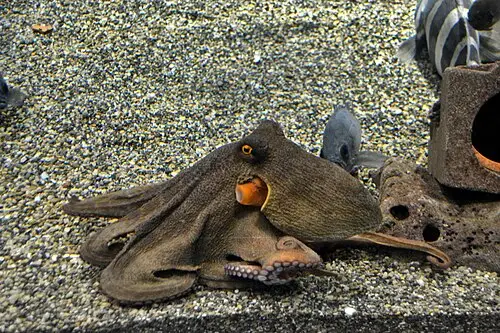
 📸 Photo
Photo: Kingfisher · CC BY-SA 3.0 · Wikimedia Commons Source
East Asian common octopus
Octopus sinensis (East Asian common octopus · マダコ)
Not Evaluated (NE) on the IUCN Red List yet.
💡 Everyday Comparisons for Size, Mass & Speed
- 💡 Its total length of 1.3 m is close to 1/3 the length of a passenger car (about 4.5 m) (Comparison).
- 💡 Its maximum weight of 3 kg is about 1/7 of a 20 kg bag of rice (Comparison).
- 💡 Along the coast of Tongyeong and Sacheon in Gyeongsangnam-do, it has been studied as a commercially important octopus caught with traps such as pots, and Korean fishing vessels have actively harvested it (Korean Journal of Malacology 2009).
Reference standards: coach bus ~12 m, mid-size car ~4.9 m, compact car ~1 t, basketball hoop 3.05 m, credit card 8.56 cm.
Site-computed relative index from recorded values; not a formal scientific metric.
📖 1. Overview
The East Asian common octopus, called madako in Japan, was long considered the same species as the common octopus (Octopus vulgaris), but a 2016 Tohoku University study showed it to be a distinct species. It lives in warm continental shelf waters of East Asia, including the Japanese archipelago.
🦴 2. Anatomy & Morphology
Full-grown East Asian common octopuses have a broader head, shorter arms, and about 80 fewer suckers per arm than Octopus vulgaris. The male's third right arm used in mating has 120–140 suckers, fewer than in Octopus vulgaris (150–190).
🔍 3. Ecology & Behavior
In stomach contents from coastal waters off Yeosu (recorded as Octopus vulgaris in the paper), decapods such as shrimp and crabs were most common at 43.9%, followed by fish (27.9%) and cephalopods (21.8%). Studies on the south coast of Korea estimated its spawning seasons to be May–June and September.
🇰🇷 4. Connection to Korea
It is listed on the National List of Species of Korea under Cham-muneo (Korean name, under the former scientific name Octopus vulgaris) and is distributed nationwide. It is noted as having high value as an edible fishery resource, though its numbers are declining due to overfishing.
📚 Sources & References
- • IUCN Red List: not evaluated (NE) — cross-checked with the Wikidata conservation-status entry
- • marinespecies.org — aphia.php
- • wikidata.org — Q61684087
- • commons.wikimedia.org — File:Octopus sinensis (Osaka Aquarium KAIYUKAN).jpg
- • species.nibr.go.kr — mainHome.do
- • tohoku.ac.jp — japans common octopus.html
- • scholarworks.gnu.ac.kr — 68406
- • scholarworks.gnu.ac.kr — 27029
- • Silhouette: PhyloPic — Margot Michaud · CC0 1.0 (Congeneric silhouette — Octopus)
Recorded dimensions are widely cited representative estimates from public literature and may vary by study or specimen.